AI servers require precision-machined liquid-cooled connectors because 700-1,400W GPUs and 50-100kW cabinets have brought traditional air cooling to the limit. Swiss CNC lathe is suitable for processing such small metal parts because it can maintain tight coaxiality, smooth sealing surface, precise threads and repeatable micro-structures in an automated clamping.
When the calorific value of a single cabinet reaches 50-100 kW, ordinary connectors cannot be regarded as only conventional hardware. If the quick-disconnect connector (QD connector) leaks near the GPU tray, the reliability of the entire liquid cooling circuit cannot be guaranteed.
Why has AI Server Liquid Cooling Become A Connector Problem?
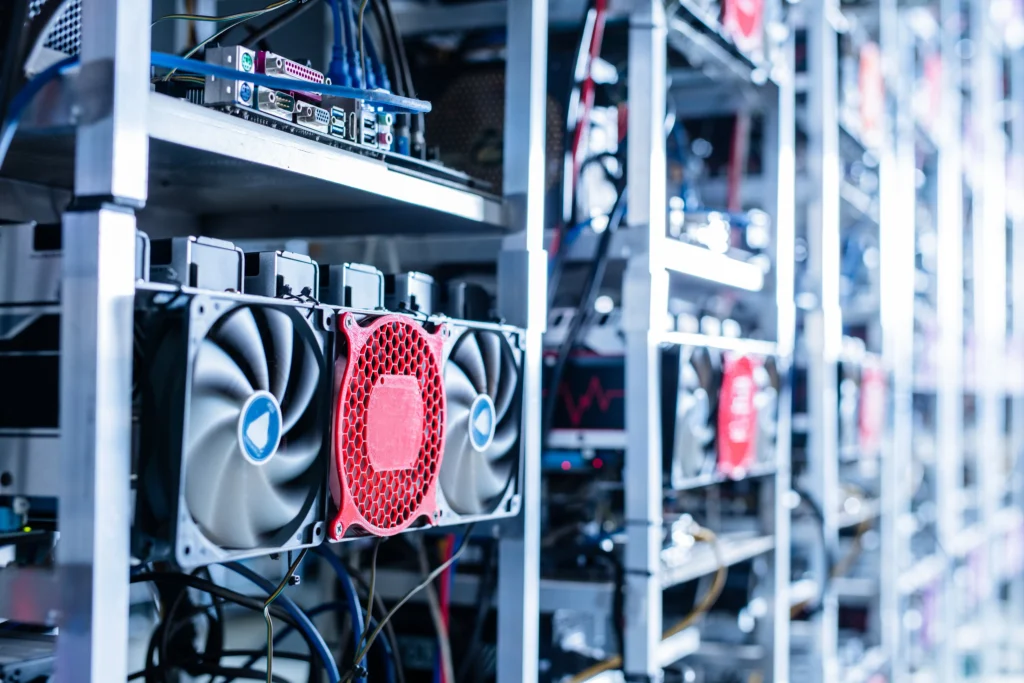
Since the GPU power consumption has risen faster than the traditional airflow cooling capacity, liquid cooling is changing from an optional solution to a cabinet-level infrastructure. The thermal design power (TDP) of the NVIDIA H100 SXM can reach up to 700W, while Blackwell Ultra data shows that the B200 can reach up to 1,200W, and the B300 can reach up to 1,400W. This does not mean that the calorific value of each cabinet will increase by three times immediately, but means that the number of connectors, coolant flow stability and maintenance reliability will become part of the thermal design.
For cabinet planning, the key pressure point is the rack density. The Uptime Institute lists high-power cabinets exceeding 50 kW as a common application scenario for liquid cooling. Supermicro also pointed out that the power consumption of a single AI server can be close to 12 kW, and the heat of a single AI cabinet can exceed 100 kW. Under such conditions, the system’s weak links are no longer limited to cold plates, but also involve the coolant distribution unit (CDU), rack manifold, and every connector between the server tray and the cold plate.
AI Server Liquid Cooling Connectors: QD, Cold Plate, and Manifold Interfaces
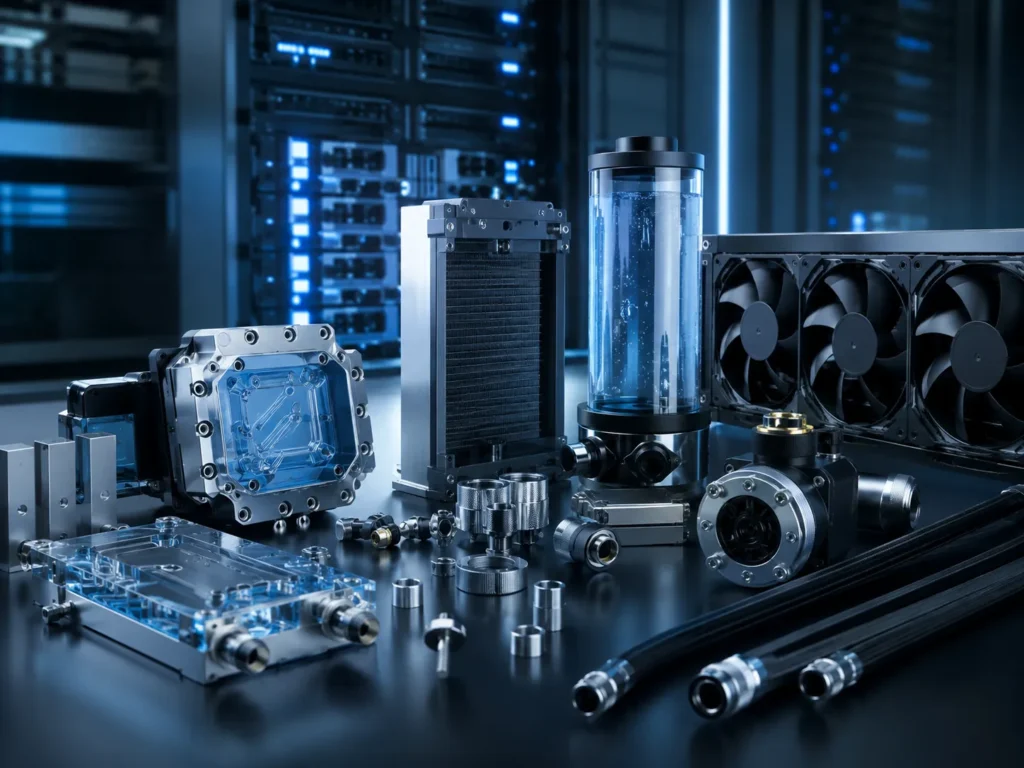
Direct-to-chip liquid cooling is a complete loop, rather than a single part, so the connector quality will affect the entire coolant path. Core parts usually includes:
- Cold plate: take away heat directly from the GPU, CPU, memory module or accelerator package.
- Manifold: evenly distribute coolant in the server tray or cabinet area.
- Quick-disconnect connector/QD connector: enables maintenance personnel to install, remove, or replace equipment without emptying the entire circuit.
Based on the resources provided by OCP in terms of cold plate and cooling environment, the industry is standardizing around cold plate, blind-mate quick connector and universal quick disconnect/UQD. These tasks clearly point in one direction: AI server liquid-cooled connectors must support repeated insertion and extraction, low liquid loss, low pressure drop, and stable alignment in high-density mechanical space. These requirements are not only thermal management issues, but also manufacturing issues.
In actual connector production, the most critical machining features include sealing face, O-ring groove, internal flow bore, valve seat, coupling thread and concentric mating diameter. The appearance of a cold plate manifold connector may be relatively simple, but the interior may also contain thin-walled structure, deep hole, radial hole, chamfer, micro burr control and other characteristics, and often use stainless steel or brass material processing. Ordinary lathes can process simple cylinders, but Swiss CNC lathe is more suitable when the parts are small, slender, threaded, and contain liquid channels with cross-drilling.
Precision-Machined Liquid Cooling Connectors: ±0.01mm, Ra ≤ 0.8μm and Leak-resistant Construction

Because the coolant flows near expensive electronic components, the connector accuracy should not be considered as an appearance requirement, but as a risk control requirement. For high-reliability AI server liquid cooling connectors, the practical processing target of key sealing and mating dimensions is usually ±0.01 mm. The roughness of the sealing surface or the liquid surface can be planned according to Ra ≤0.8μm, and it needs to be verified within the pressure range corresponding to the application conditions. If the project requires 1.0MPa zero leakage, the machining process must ensure both dimensional accuracy and surface integrity.
Three types of failure are particularly noteworthy:
- Size mismatch: too large sealing groove may lead to insufficient compression of O-ring, and too small sealing groove may cause over-compression and shorten the life of seals.
- Surface damage: vibrating marks, knife marks and burrs can form leakage channels even if the nominal diameter is correct.
- Contamination: the remaining chips in the cross hole or blind hole may enter the microchannel cold plate, reducing the flow rate or causing blockage.
Why is Swiss CNC Lathe the Ideal Platform for Small Fluid Connectors?
Swiss CNC Lathe supports the bar near the cutting point through the guide bushing, which can reduce the deflection of small diameter and high aspect ratio parts during machining. This is the core difference between Swiss CNC lathe and conventional CNC turning center. For the connector poppet, valve sleeve, nozzle body, female body and stepped fluid fitting, the stability of the cutting area is very important when machining seal groove, chamfer, thread and cross hole.
This is particularly important when AI server liquid cooling connectors are made of stainless steel, nickel-plated brass or other corrosion-resistant materials. These materials are prone to produce higher tool pressure, burrs and heat during machining.
Swiss type lathe is not the only metal cutting equipment, but it is usually a more efficient and ideal manufacturing platform for small, precision mass production of precision-machined liquid cooling connectors. It can complete turning and milling in one clamping, support automatic feeding, allow the sub-spindle to perform back processing, and reduce workpiece transfer. For liquid-cooled connector suppliers, this means less fixture errors, shorter processing beats, and more stable connector quality.
You can further read the guide about CNC Swiss Lathe vs. Conventional CNC Lathe.
Why is Jianke MA25-6SP Suitable for AI Server Liquid Cooling Connector Supply Chain?

AI data centers are rapidly expanding, and parts supply chains need more than just sample processing capabilities. MarketsandMarkets predicts that the data center liquid cooling market will grow from about USD 4.07 billion in 2026 to about USD 27.65 billion in 2033. Grand View Research predicts that the market size will be about $ 29.46 billion by 2033. Different research institutions have different modeling methods, but the conclusion is consistent: liquid cooling is becoming the mainstream data center infrastructure category.
This leads to a practical manufacturing problem: how can connector/fitting suppliers maintain sealing accuracy while expanding production capacity?
For connector manufacturers, the correct focus is not simply to ask the device “whether the number of axes is sufficient”. The more accurate selection of Swiss CNC lathe should be: can the sealing structure size be maintained stably? Can the repetition accuracy be maintained in the automatic production of bars? Can the internal flow channel chips be effectively discharged? Can secondary processing be reduced? When the project involves AI server liquid cooling connectors, these problems will directly affect the yield, leakage risk and delivery stability.
Jianke Machinery can position MA25-6SP as a high-value Swiss CNC Lathe for QD connector body, cold plate joint, manifold interface, female body, valve sleeve, precision elbow and small thread coolant interface manufacturers. When evaluating the suitability, the part diameter, material, dimensional tolerance, hole depth, thread type, radial hole layout, target surface roughness, processing beat and pressure test requirements should be compared and confirmed one by one with the JIANKE technical team.
Read the guide learning about Jianke MA25-6SP Swiss type lathe in depth:
Jianke MA25-6SP Swiss Type Lathe: Complete Guide To The Double Spindle Precision CNC Machine
Conclusion
The AI server requires precision-machined liquid cooling connectors. Because of higher GPU power consumption, higher density cabinets, and maintainable liquid cooling circuits, each QD, cold plate joints, and manifold interfaces are critical parts that affect system reliability. Swiss CNC lathe is an efficient manufacturing platform that can reduce flexural deformation, support multi-process compound machining, and maintain repeatability on small metal parts. If a connector manufacturer that is entering the AI server liquid cooling supply chain has doubts, JIANKE is happy to answer your questions.
FAQ
AI servers require liquid-cooled connectors because direct-to-chip liquid cooling relies on a closed coolant circuit. The connector is used to connect cold plates, manifolds, CDUs, and maintenance interfaces, while supporting installation and maintenance without redesigning the entire cabinet.
Yes. For small precision QD connector bodies, Swiss CNC lathes are usually more suitable, because the guide sleeve support can reduce the deflection deformation and keep the turning, drilling, milling and tapping aligned in one clamping.
For key sealing structures, many projects target ±0.01mm, but final tolerances should be determined based on connector design, materials, O-ring compression and pressure test requirements. The position where the tolerances need to be most strictly controlled is usually the diameter and the sealing groove.
Because the rough sealing surface may form a leakage path, the rough internal pores may increase the pressure drop or retain the particles. For high reliability connectors, Ra ≤ 0.8μm can be used as a practical target for sensitive sealing surfaces or liquid contact surfaces.