Achieving micron-level accuracy while maintaining high productivity is the core goal in advanced manufacturing. For machining shops and industrial manufacturers, the Jianke MA25-6SP Swiss type lathe machine has become an efficient solution for the production of liquid-cooled joints for AI servers, complex medical implants and precision aerospace fastener heads.
What is Jianke MA25-6SP Swiss Type Lathe?
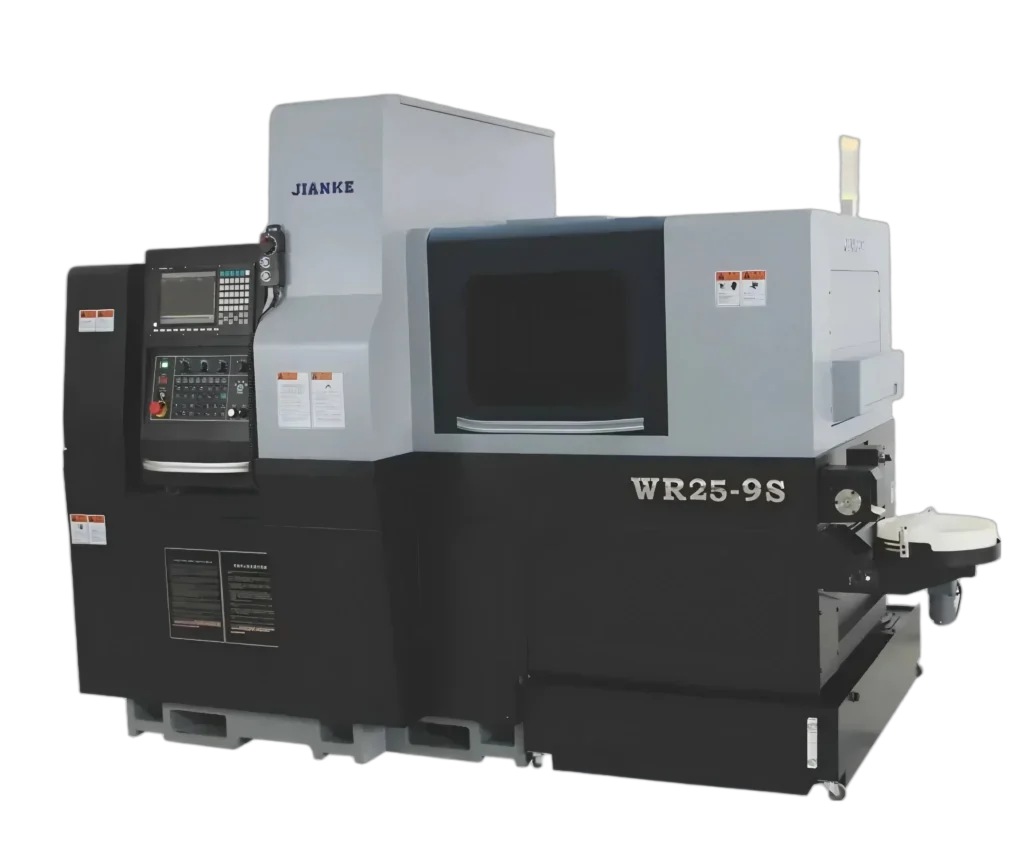
Jianke MA25-6SP Swiss type lathe is an advanced computer numerical control (CNC) machine tool, which is designed for turning parts with complex shape, slender and high precision. Different from the traditional lathe which fixes the workpiece through the chuck, the Swiss type lathe allows the material to slide through the guide bush, and the cutting tool is cut close to the end face of the guide sleeve. This design fundamentally eliminates the part deflection (tool letting phenomenon) and ensures that absolute accuracy can be achieved even when machining long shaft workpieces. By integrating modern innovative technologies such as dual spindles and flexible guide bush systems, the device integrates mass production capabilities with flawless micro-machining accuracy.
Learn about Jianke MA25-6SP Swiss type lathe
| Spec. | Origin and Brand |
|---|---|
| Operation System | SYNTEC(Made in TAIWAN) |
| Spinlde and Driver | Oil cooling electric spindle/Mitsubishi driver |
| Bearing | Japan NSK |
| Guide rail | Japan THK/Taiwan Hiwin/Taiwan PMI |
| Guide screw | Japan THK/Taiwan Hiwin/Taiwan PMI |
| Servo Motor | SYNTEC(Made in TAIWAN) |
| Motor driver | SYNTEC(Made in TAIWAN) |
| Electrical components | France Schneider |
| Lubricant system | Japan Herg |
| Relay | Japan Omron |
| Stroke switch | Japan Omron |
| Magnetic valve | Taiwan Airtag |
To understand why this machine can dominate in similar products, we must explore its internal structure. The core characteristics of this advanced Swiss CNC lathe machine are introduced below.
How does the guide bush system work?
One of the most powerful functions of Jianke MA25-6SP Swiss type lathe is its high adaptability. It supports rotary guide bush/without guide bush changeable modes, which allows the operator to switch configurations according to the specific geometry of the part to be processed.
Rotary guide bush mode: When using rotary guide bush machining, the Swiss type lathe can perfectly adapt to the long shaft workpiece. Its single feeding length can reach 195mm to 200mm, and supports multiple feedings to process longer parts. The required length of the remaining tail material (waste) is 180 mm in this mode.
No guide bush mode: why to remove the guide bush? When the ratio of length to diameter is less than 1: 2.5, the guide bushless mode is very advantageous. This mode can significantly reduce material waste and shorten the tail length to only 50 mm.
| Feature | Rotary Guide Bush Mode | Without Guide Bush Mode |
|---|---|---|
| Best Used For | Long shaft workpieces | Short, stout workpieces |
| Max Single Feed Length | 195 ~ 200 mm | Depends on part (Ratio < 1:2.5) |
| Tail Material Length | 180 mm | 50 mm (Minimizes waste) |
| Length/Diameter Ratio | High ratio (Slender parts) | Low ratio (< 1:2.5) |
Why use the built-in oil-cooled motorized spindle?
Thermal expansion is one of the main factors affecting precision machining accuracy. In order to solve this problem, the Jianke MA25-6SP Swiss type lathe is equipped with a built-in oil-cooled electric spindle derived from Japanese technology. Through independent design and continuous research and development, the spindle successfully solves the common core thermal deformation in high-speed CNC turning.
Compared with other motorized spindles with the same power, the spindle system has significantly stronger rigidity and torque, thus ensuring the stability of machining accuracy. In addition, the spindle adopts high-quality NSK bearings, which not only enhances the radial stability, but also significantly prolongs the service life.
How does the coolant and chip management system work?
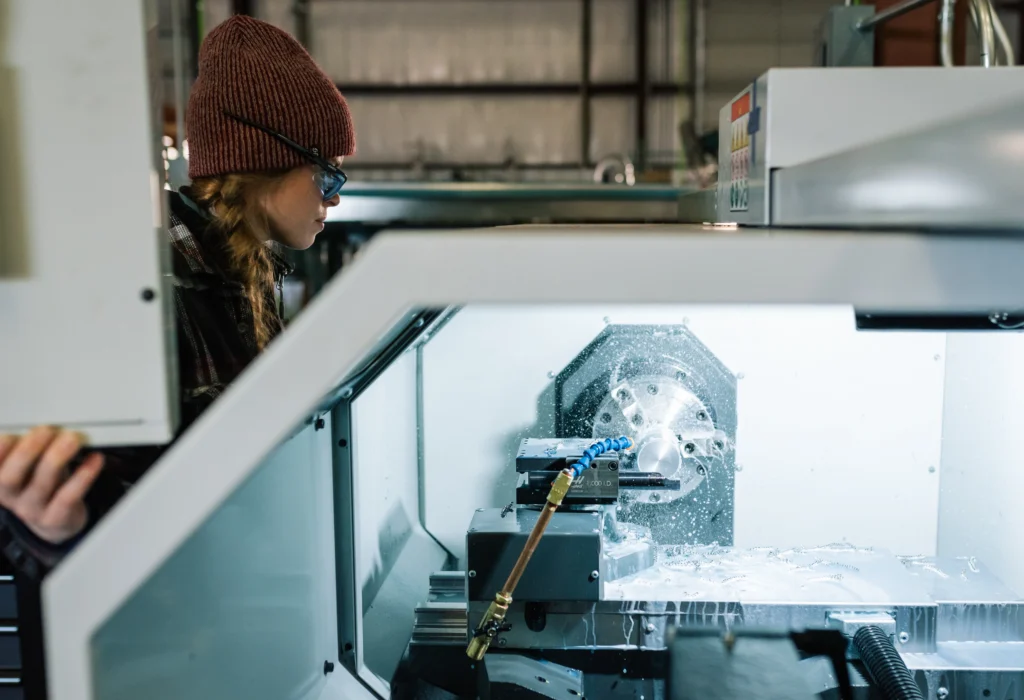
Large quantities of processing will produce a lot of heat and metal chips. Jianke MA25-6SP Swiss type lathe deals with these problems through the cooperation of waste collection tanks and large capacity cutting oil tanks.
The chip collection box has a chip separation platform. The cooling oil is buffered and cooled here to complete the initial separation of cutting oil and metal chips. Subsequently, the cooling oil enters the cutting tank with a volume of 250 liters from the oil discharge port. The oil tank is equipped with multiple filters and oil return baffles to extend the oil return path of the fluid. The longer oil return path enables the cutting oil to be fully cooled naturally, and minimizes the removal of tiny debris to avoid debris entering the oil pump, thereby extending the service life of the oil pump.
What are the ways of workpiece discharge?
The handling and cutting method of the workpiece is very important to prevent the damage of the finished product. The full range of dual spindle Swiss CNC lathes, including Jianke MA25-6SP, are equipped with a highly flexible collection method for front discharge products.
Short parts (< 90mm): When the length of the workpiece is less than 90mm, the equipment adopts the front discharge method. The parts will safely fall into the front receiving box and are smoothly sent out of the processing area through the built-in conveyor belt.
Long parts (> 90mm): For products with a length of more than 90mm, the rear discharge method can be selected. The finished product will be ejected through the center hole of the sub-spindle and slide out from the special groove of the sheet metal on the side of the equipment, so as to effectively avoid the clamping and surface scratch of the long shaft parts.
Raw Material Requirements for Jianke MA25-6SP Swiss Type Lathe

Even the most advanced dual spindle Swiss CNC lathe cannot produce accurate parts if inferior materials are input. Because the processing of the Swiss type lathe depends on the smooth sliding of the material in the guide bush, the consistency of the raw material is very important. The following are the raw material preparation procurement guidelines that must be strictly followed when using the Jianke MA25-6SP Swiss type lathe to process long bar materials.
What is the most suitable raw material for Swiss type lathe processing?
Material surface finish: It is strongly recommended to use precision drawn bar materials or grinding bars. Since the maximum bar length supported by the standard feeder is 3 meters, it is recommended that the length of a single bar should be controlled at ≤ 3M.
The outer diameter tolerance: The consistency of the outer diameter tolerance of the material must be kept within ± 0.02mm. If the material is too thick, it will be stuck in the guide sleeve ; if too fine, it will cause vibration and destroy the surface roughness of the parts.
Roundness tolerance: The consistency of material roundness must be strictly controlled between 0.005mm and 0.01mm.
Straightness requirements: In order to prevent catastrophic vibration of the material at extremely high speeds, the straightness requirements of the bar must be within 0.35mm/m.
End face treatment: Both ends of all bars must be chamfered to ensure that they can be smoothly fed into the collet.
Special-shaped materials: When processing large-diameter or special-shaped materials (such as square or hexagonal bars), the operator must turn the tail of the bar into a cylindrical shape. This ensures that the material matches the feeder chuck and passes easily through the spindle hole.
Material hardness: If the hardness of the raw material is higher than HRC28, it must be declared (informed) to the process and commissioning team in advance to ensure that it is equipped with the appropriate cutting blade and the correct spindle speed.
Jianke MA25-6SP Swiss Type Lathe Application
Why does modern manufacturing need Jianke MA25-6SP Swiss type lathe? Jianke MA25-6SP Swiss type lathe is not only a general machine tool that is a professional equipment designed for high-demand industries.
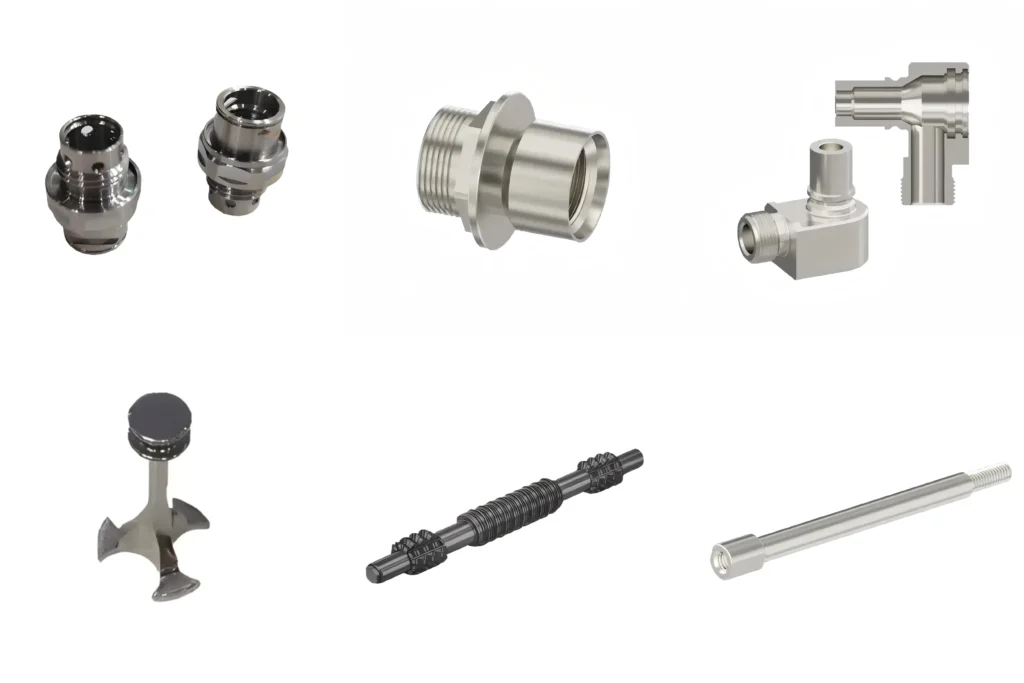
Manufacture of medical devices: The production of titanium alloy bone screws, dental implants and surgical instruments requires micron-level tolerances. The device’s oil cooled electric spindle effectively prevents thermal deformation and ensures that every implant is accurately compliant with FDA or CE standards.
Aerospace parts: Aviation pins, connectors and miniature fasteners are usually made of high-strength difficult-to-machine alloys. Its high-rigidity spindle and precise rotary bush guide machining capability allow deep cutting on hard materials without part deflection.
Automotive electronics: With the increasing computerization of vehicles, the demand for miniature, high-precision sensor housings and connector pins has increased dramatically. The dual-spindle design supports the simultaneous processing of the front and back sides of the parts, which greatly shortens the production cycle of automobile mass orders.
AI server liquid cooling connector: The demand for AI server liquid cooling connector is growing rapidly due to the outbreak of AI computing power, and has entered the outbreak period of rising volume and price. The liquid cooling connector is the key to the heat dissipation of the AI server, which requires high accuracy. Jianke MA25-6SP Swiss type lathe are designed to combine high precision and high efficiency to cope with explosive growth and AI liquid cooling heat dissipation needs.
How Should We Optimize the Use of Swiss Type Lathe?
Operation optimization is the point to maximize the value of your Jianke MA25-6SP Swiss type lathe.
First, select the appropriate guide bush setting according to the geometry of the part. For parts with small length-diameter ratio, the non-guide bush mode should be used to reduce the tail material loss.
Secondly, precision drawn bar materials must be strictly used. The use of cheap, ungrounded or bent rods can lead directly to tool breakage, downtime and scrapped parts.
Finally, please properly maintain the cutting tank with a capacity of 250 liters. Although the multi-channel filter can effectively protect the oil pump, it is still necessary to regularly clean the chip separation platform to ensure that the coolant is maintained at an appropriate temperature, which is directly related to the service life of the tool and the surface finish of the workpiece.
Conclusion
Jianke MA25-6SP Swiss type lathe shows the advanced level of modern turning technology. By integrating an oil cooled electric spindle, providing a dual guide sleeve switching mode, and equipped with an intelligent waste and workpiece discharge scheme, this machine has become a dual spindle Swiss CNC lathe machine with excellent performance.
Whether you are building a new production line or upgrading an existing machining workshop, understanding of its technical parameters and strict compliance with raw material requirements will help you achieve excellent machining accuracy and considerable profit margins.
FAQ
Swiss type lathes (like JIANKE MA25-6SP) use a sliding headstock and guide bushing that supports the bar stock very close to the cutting tools, minimizing deflection for long, thin, high-precision parts. Conventional lathes hold the workpiece rigidly, making them less ideal for small-diameter, high L/D ratio components. Swiss type lathe machines excel in medical, aerospace, and electronics parts.
It is ideal for medical devices (implants, screws), aerospace (connectors, fittings), electronics, automotive, and watch/jewelry industries. Its dual-spindle design and 6-axis capability allow efficient production of complex, tight-tolerance parts in high volumes.
The dual-spindle setup allows simultaneous machining on main and sub-spindles, reducing cycle times significantly. It enables complete part processing in one setup (turning, milling, drilling on both ends), improving accuracy, reducing handling, and boosting productivity by up to 2x compared to single-spindle machines.
Yes, it features a versatile rotary guide bushing system. Use the guide bush for long, slender parts requiring maximum stability and precision; switch to non-guide bush mode for shorter parts or when easier bar feeding/setup is needed. This flexibility is a major advantage for varied production runs.
It uses user-friendly SYNTEC CNC with dual-channel control, making programming and operation straightforward for experienced machinists. Maintenance involves standard practices like guide bushing lubrication, tool changes, and spindle checks. The robust build ensures reliability; many users report low downtime with proper training.