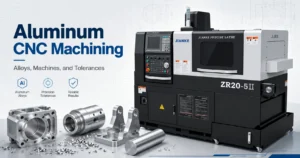
Are you worried about thin-walled deformation and rising inspection costs when processing lightweight parts? Is it uncertain which one of the machining centers, ordinary CNC lathes or Swiss type lathes is more suitable for your part structure? The final result of aluminum CNC machining depends on a number of interrelated conditions, including aluminum alloy grade, blank form, tool, fixture, tolerance and surface treatment. Any selection error may cause vibration pattern, deformation, size drift or batch consistency decline.
Why Aluminum CNC Machining Fits Precision Production?
In 2025, North American aluminum demand reached 26.65 billion pounds, an increase of 0.8% year-on-year. Such a large scale of demand shows that the aluminum supply system has been relatively mature. However, when performing aluminum CNC machining, it is still necessary to select the appropriate process according to the blank form, part structure and production quantity. It is not possible to directly put into production simply because the aluminum material is easy to cut.
Aluminum alloy has low density, good corrosion resistance and טערמאַל קאַנדאַקטיוואַטי, and high strength can be obtained after alloying. It is commonly used in electronic equipment housings, hydraulic valves, optical mounts, mechanical supports, cooling system parts, and transportation components.
However, the heat treatment state, grain direction, residual stress and blank form of aluminum alloy will affect the deformation degree of parts after removing a large amount of materials. Even if the same drawing is produced using different batches of sheet or bar, the final dimensional stability may vary.
Before selecting the machine tool, it should be classified according to the geometric structure of the parts. Box-type or non-rotating parts with plane, cavity and multi-faceted features are usually suitable for machining centers. Shafts, sleeves, connector housings and threaded cylindrical parts are more suitable for turning.
For small diameter bar parts, if they also contain transverse holes, milling planes or eccentric features, Swiss-type CNC lathes can usually be selected. This device can complete turning, drilling, milling and back processing in one machining cycle.
In addition, it is also necessary to distinguish between sample manufacturing and mass production. The sample stage can accept soft claws, multiple clampings and longer tuning time. Batch production requires stable positioning benchmarks, repeatable fixtures, tool life management, and detection schemes that do not frequently interrupt the machining cycle.
Which Aluminum is Best for CNC Machined Parts?
In the study, the 7050-T7451 specimen with a wall thickness of 1 mm showed the most obvious instability during processing, and the processing stability was better when the wall thickness was 2 mm. Under the condition of 48 mm wall height, at least 1.5 mm wall thickness is needed to maintain the dimensional accuracy and shape accuracy. This shows that choosing the alloy cannot be judged separately from the geometric structure of the part.
6061-T6 is usually the preferred material for making CNC machined aluminum parts. It has stable processing performance and good anodic oxidation adaptability. It is commonly used in fixtures, casings, manifolds, brackets and general mechanical parts.
7075-T6 is suitable for bearing parts with high strength-to-weight ratio requirements. Compared to 6061, its material costs are usually higher, and corrosion treatment and surface protection schemes need to be planned more carefully.
2024 aluminum alloy is suitable for parts with high fatigue performance requirements, but additional protective surface treatment is usually required. 5052 is more suitable for sheet parts that need to be formed or welded, and is not suitable for heavy milling with large cutting depth and high material removal rate.
6082 is a 6xxxx series aluminum alloy with good supply conditions in some areas. For thick plate aviation parts, if they have material certification and stable process control capabilities, 7050 aluminum alloy can also be considered.
| צומיש | טיפּישע CNC טיילן | Main reason to select it | וואַך פונקט |
|---|---|---|---|
| 6061-T6 | Housings, brackets, manifolds | Balanced machining and finishing | נידעריקער שטאַרקייט ווי 7075 |
| 7075-T6 | Loaded frames and arms | הויך שטאַרקייַט-צו-וואָג פאַרהעלטעניש | Cost and corrosion planning |
| 2024-T3/T4 | Fatigue-loaded components | גוטע מידקייט פאָרשטעלונג | Protective finish often needed |
| קסנומקס-הקסנומקס | Sheet-based machined parts | Formability and corrosion resistance | Not ideal for heavy milling |
| 6082-T6 | Structural machine parts | Structural 6xxx-series option | רעגיאָנאַל אַוויילאַבילאַטי |
| 7050-T7451 | Thick aerospace plates | Through-thickness performance | Certification and stress control |
What CNC Machine for Aluminum Produces the Best Result?
In a study in 2026, Xu and Verl tested a five-axis contour with 100,000 detection points. The results show that compared with an industrial CNC system kernel, the optimized feed planning shortens the finishing time by more than 15%. This shows that the kinematic performance, CNC system and tool path of the machine tool are equally important when selecting a CNC machine for aluminum.
די 3-אַקס מאַשינינג צענטער is suitable for processing sheet metal, open cavity and parts that only need to be approached from a few directions. If the part needs to process multiple surfaces around a rotating shaft, a fourth shaft can be added to reduce manual re-clamping.
די 5-אַקס מאַשינינג צענטער is suitable for processing inclined holes, curved surfaces or complex features distributed in multiple directions. 5-axis machining is often a more effective choice when using 3-axis machines that require the design of multiple sets of fixtures or frequent adjustment of benchmarks.
Conventional CNC lathes are suitable for processing shafts, bushings, flanges and medium-length cylindrical parts. If the part also contains a milling plane, radial hole, keyway or eccentric features, a turn-milling machine tool with live tooling and Y-axis can be selected.
If you want to know live tool in detail, refers to JIANKE’s Best Live Tooling On CNC Lathes: 7 Expert Tips To Maximize Precision.
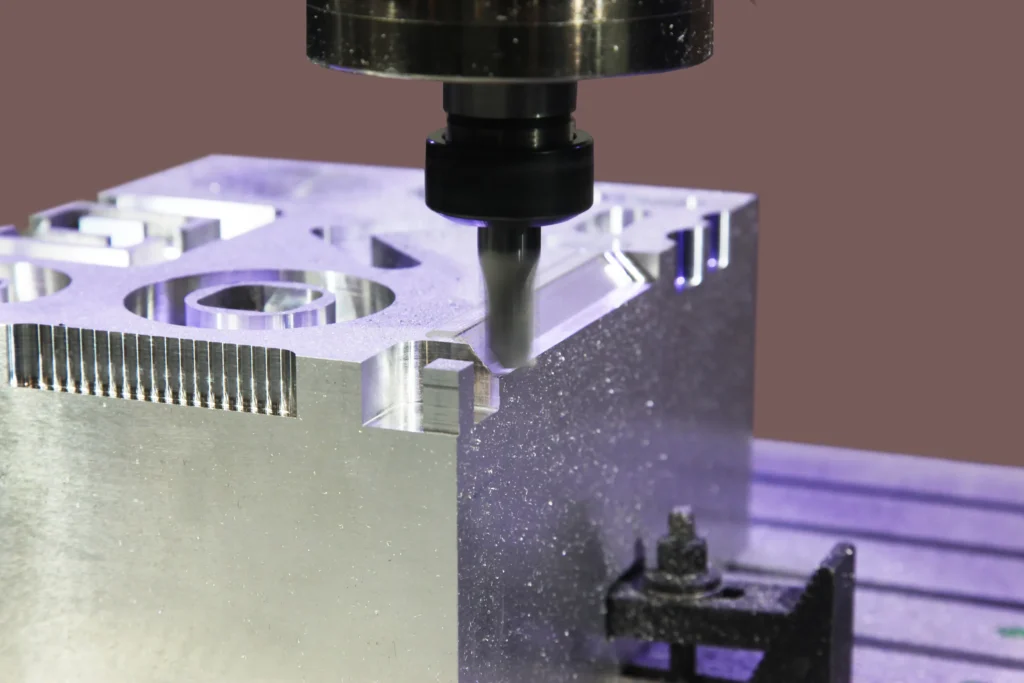
For slender, small-diameter bar parts, the Swiss type aluminum CNC machine support the material near the cutting area through a guide sleeve. This structure is conducive to reducing the deflection of the bar, and can integrate turning, drilling, milling and back processing in one machining.
It is impossible to make up for the problems of insufficient rigidity of fixture, too long overhang of tool, wear of spindle bearing or poor thermal stability only by high spindle speed.
A truly suitable machine tool should be able to complete all geometric features with the least and most stable number of clamping times. Before selecting the equipment, you can first compare the applicable differences between the Swiss type CNC lathe and the conventional CNC lathe. If both ends of the part need to be processed and contain multiple radial features, it can also be evaluated whether the 9-אַקס CNC דרייבעט can integrate the processing procedures.
Learn more details about the differences between Swiss type CNC lathe and the conventional CNC lathe → JIANKE’s CNC Swiss Lathe Vs. Conventional CNC Lathe: Which Is Right For Your Manufacturing Needs?
How Should Aluminum CNC Milling Control Tools, Chips, and Thin Walls?
A review of low-stiffness thin-walled parts published in the “CIRP Journal of Manufacturing Science and Technology” in 2025 pointed out that the initial material removal rate of thin-walled parts can usually reach 80% to 90%.
In this study, cutting force, cutting heat, residual stress, fixture state and chatter are associated with part deformation. Therefore, aluminum CNC machining needs to plan rough machining and finish machining separately, and cannot use the same group strategy to complete all processes.
The tool should give priority to the geometric structure designed for non-ferrous metal processing. The sharp cutting edge, polished chip removal groove, sufficient chip space and low tool runout help to reduce the build-up edge and make the chip leave the cutting area smoothly.
Two-edge and three-edge סוף מיללס are commonly used in aluminum CNC milling, because these two tools usually have a larger chip removal space. However, the final tool selection still needs to be comprehensively judged by tool diameter, radial cutting width, axial cutting depth, machine power and cooling mode.
The same set of speed and feed parameters cannot be directly copied to different machine tools. The spindle speed is determined by the cutting speed and the tool diameter, while the feed speed is determined by the feed per tooth, the number of edges and the spindle speed.
Rough machining and finish machining must be planned separately. After rough machining, a uniform margin should be retained to avoid directly processing a side wall to the final size prematurely. For symmetrical structures, both sides can be processed in a relatively balanced order to reduce the deformation caused by internal stress release.
The aforementioned 2025 study found that under its test conditions, 1 mm wall thickness showed obvious chatter, while the processing stability of 2 mm wall thickness was improved. This result can be used to identify high-risk designs, but should not be used as a universal minimum wall thickness for all aluminum alloy parts.
Repeated chip cutting will cause surface scratches, local temperature rise and aluminum adhesion on the blade. Internal cooling, spray cooling, micro-lubrication or directional compressed air can be used, but no matter which one is selected, the chip must be continuously discharged from the cavity and cutting area.
When setting the machining reference and tool compensation, you can refer to the CNC lathe tool offset and workpiece zero setting guide. If you want to shorten the processing cycle, you can also check the clamping, tool change and processing sequence in combination with the CNC metal lathe processing efficiency check list.
FAQ
6061-T6 is usually suitable for general aluminum CNC machining, 7075-T6 is suitable for high load parts, and 7050 can be used for thick plate parts with higher requirements. No brand can be suitable for all designs.
For aluminum CNC machining, use a machining center for prismatic parts, a conventional lathe for simple round parts, and a Swiss-type lathe for slender bar-fed components with secondary features.
There is no uniform minimum wall thickness for all parts, because the wall height, alloy, fixture, tool and machining path will change the structural stability.
Chatter is usually related to insufficient system rigidity, long tool overhang, unstable combination of spindle speed and cutting width, insufficient fixture support or continuous decrease of thin-walled stiffness. The rough machining stage of thin-walled parts may remove 80% to 90% of the initial material, and the structural stiffness will change significantly during the machining process.
Costs can be reduced by reducing the number of clampings, avoiding unnecessary thin-walled structures, using standard tools and fillets, distinguishing key dimensions, and selecting blanks close to the final shape. Optimizing the tool path can also directly reduce the machining cycle.
סאָף
High-quality aluminum CNC machining should start with the geometric structure of the parts, and determine the aluminum alloy brand, machine tool structure, tool, deformation control, detection scheme and surface treatment in turn.
Use a machining center for prismatic parts and a Swiss type CNC lathe for small bar-fed components with turned and milled features. For the second group, Jianke Machinery’s Swiss type machine range should be evaluated against diameter, length, live-tool, sub-spindle, and volume requirements.