The Swiss lathe supplier for AI liquid cooling connectors should focus on five capabilities: multi-axis Swiss type equipment, ±0.005-0.01 mm critical tolerance control, CMM inspection, 100 % leak/air-tightness testing and stable batch production capacity. For AI server component sourcing, the safest Chinese supplier is not the factory with the lowest quotation, but the manufacturer that can provide repeatable sealing surface accuracy and controllable batch quality.
If a connector is small in size, threaded, needs to be sealed, and needs to withstand multiple assembly and use cycles in a liquid-cooled AI cabinet, the ordinary CNC quotation scheme cannot meet the requirements. Because the processing capacity of Swiss lathe will directly affect the coaxiality, inner hole quality, sealing groove accuracy and batch stability, AI hardware manufacturers must first complete system verification before including Chinese suppliers into formal procurement.
Why are AI Hardware Manufacturers Turning to Chinese Precision CNC Suppliers?

The cooling system is changing from auxiliary infrastructure to core design architecture in the AI hardware. As cabinet power density continues to rise, direct-to-chip liquid cooling, rack manifolds, CDUs, cold plates, and quick-disconnect connectors have become important components that affect system performance, rather than just supporting components outside the server.
Therefore, AI server component sourcing is more inclined to choose a precision processing supply chain with delivery speed, cost control and large-scale production capacity. China has three practical advantages in this field:
- China has a mature CNC machining supplier system, which can process metal parts such as stainless steel, brass, aluminum alloy and copper for thermal management components.
- Many Chinese suppliers are already familiar with export documentation, sample processes, packaging requirements and drawing-based OEM production methods.
- Local machine tool manufacturers and precision processing plants are upgrading their capabilities around AI liquid cooling demand, especially in product directions such as UQD-style connectors, manifolds, threaded fittings, and high precision liquid cooling parts OEM.
However, purchasing from China does not mean choosing the lowest quotation. The liquid cooling connector is a part that is highly sensitive to failure. A small burr in the inner hole may affect the fluid channel; coaxiality drift may lead to uneven sealing compression; if the sealing surface roughness is not up to standard, it will increase the risk of leakage. Suppliers who are competent for the production of ordinary turning parts do not necessarily have liquid cooling connectors that require stable sealing performance.
Therefore, when evaluating liquid cooling connector manufacturer China, the primary screening criterion should be manufacturing capacity, not price. Suppliers must be able to clearly explain their processing routes, inspection plans, leak test methods and capacity models before they are suitable for mass production.
If you would like to be interested in producing a liquid cooling connector, please contact the JIANKE technical team at admin@jiankemach.com.
Select the 5 Core Items that must be Verified Before Choosing CNC Precision Cooling Parts Supplier
When evaluating precision CNC cooling parts suppliers, AI hardware manufacturers should focus on 5 aspects: equipment, accuracy, testing, certification and capacity. These five validations help to distinguish between partners that can provide real mass production and processing workshops that can only provide samples.
1. Equipment: does the supplier have Swiss type lathe processing capability?
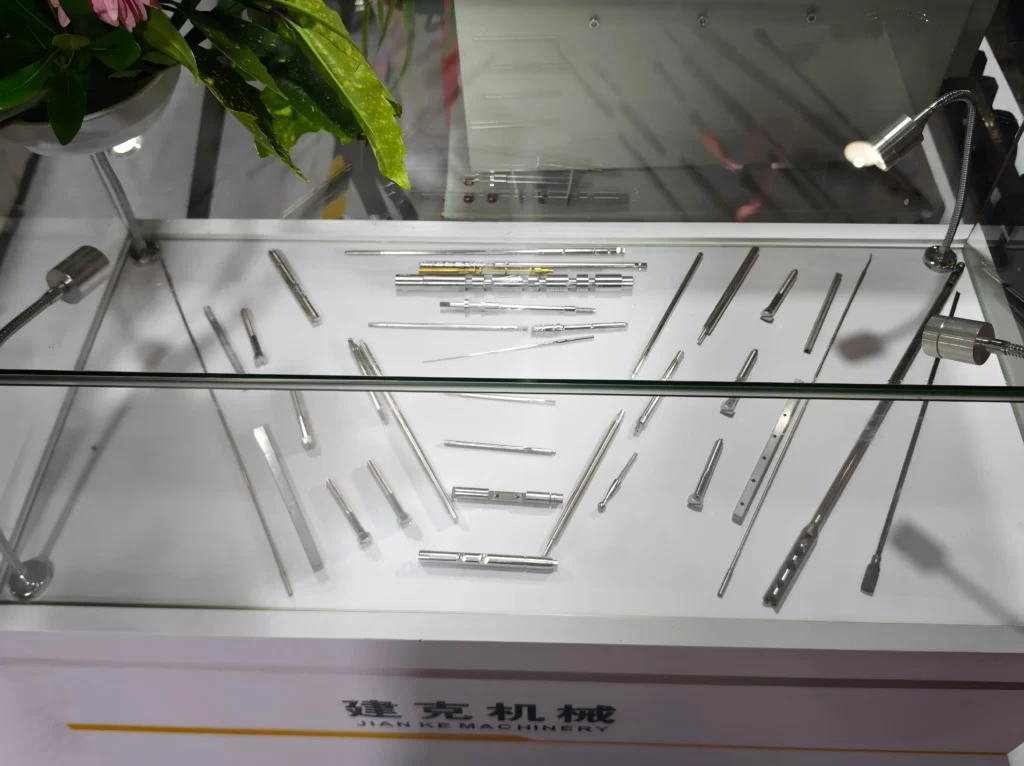
When the parts are small in size, slender in structure, with holes and threads inside, and the tolerance requirements are extremely strict, Swiss lathe is usually more suitable. The guide bushing of Swiss lathe supports the bar near the cutting tool, which can effectively reduce the bending deformation in the process of turning, drilling, slotting and tapping.
This is particularly important for liquid cooling connectors: many liquid cooling connectors integrate outer diameter sealing features, internal flow channels, thread structures, and O-ring grooves on a compact metal body.
Besides, purchasers should require suppliers to provide a true list of equipment, rather than just workshop photos. Valid information includes machine model, number of shafts, bar diameter range, sub-spindle capability, power tool configuration, and sample parts similar to the target connector.
2. Tolerances: can suppliers control key dimensions, not just easy-to-machine dimensions?
A part drawing may contain dozens of dimensions, but there are often only a few key features that really affect the sealing performance. For liquid-cooled connectors, the key points usually include sealing face flatness, O-ring groove width/depth, bore concentricity, thread fit, valve-seat geometry, and surface roughness of wetted/sealing areas.
Suppliers should be clear: which dimensions need 100% inspection, which dimensions need sampling inspection, and which dimensions need process capability tracking. As far as AI liquid cooling connector sourcing is concerned, the key sealing or positioning features can usually refer to the control target of ±0.005-0.01 mm. Final tolerances should still be based on product drawings, supporting connector structure, sealing materials and test pressure.

3. Testing: can the supplier certify that the parts will not leak?
Liquid cooling connectors cannot be judged by appearance alone. Suppliers should provide air-tightness testing, pressure decay testing, helium testing or water pressure testing depending on the application scenario.
At least sample-level pressure testing should be required in the early stage of development. In the batch production stage, 100% leak testing is recommended for sealed connector bodies, valve interfaces, and components entering direct-to-chip cooling loops.
Test records should include test pressure, holding time, leakage limit, test medium, test fixture, operator and batch number.
4. Authentication: does the quality system apply risk matching?
ISO 9001 is the basic proof that suppliers have documented quality management capabilities, covering process control, corrective measures, calibration management and customer requirements management. However, the purchaser should still further verify the calibration records, non-conforming product control, corrective action report and drawing version control.
IATF 16949 is more suitable for judging whether the supplier has the production discipline of the automobile industry or mass precision parts. Although AI hardware projects do not necessarily require IATF 16949, the system emphasizes defect prevention, variation reduction, and traceability, which are well suited for high precision liquid cooling parts OEM manufacturing.
5. Capacity: can suppliers transition from sample stability to monthly batch delivery?

Experienced operators can produce qualified samples in detail, but batch production requires stable tool management, bar control, fixture planning, detection rhythm, operator training and preventive maintenance.
Suppliers should be required to provide monthly capacity based on part number, current equipment productivity, raw material delivery date, sample delivery date, and backup plan in case of tool wear or equipment downtime before placing bulk orders.
For CNC machining data center cooling projects, capacity planning should not only focus on the number of machining, but also on the detection and testing bottlenecks. A factory may be able to process 50,000 parts per month, but can only test 10,000 components. At this point, the test capability is the actual delivery risk.
Swiss Lathe vs Ordinary CNC Lathe: Difference in Processing Capacity of Liquid Cooling Connectors
Ordinary CNC lathes can efficiently produce a variety of circular parts, but for small, complex, high-precision connector components, Swiss type lathe is usually more advantageous. The difference between the two is not a simple “high-end equipment and low-end equipment“, but rather the different support methods of the workpiece during the cutting process.
In ordinary CNC lathes, the workpiece is usually clamped from one end. When the tool is machined along a slender part, the deflection of the workpiece may increase. In Swiss lathe, the bar is fed through the guide bushing, and the cutting position is close to the support point, so the rigidity is better, which is helpful to maintain the coaxiality, surface quality and dimensional stability. Jianke has an article dedicated to explain the working principle of CNC Swiss lathe.
According to the following table, we can quickly understand the difference between Swiss lathe and general CNC lathe in processing capacity of liquid cooling connectors:
| Verification Area | Švicarski tokarski stroj | Konvencionalni CNC tokarilica | Why It Matters for Liquid Cooling Connectors |
|---|---|---|---|
| Podupirač obratka | Guide bushing supports material near cutting point | Chuck support is farther from some cuts | Better control of deflection on small or slender connector bodies |
| Small complex parts | Strong fit for small turned parts with grooves, threads, bores, and cross features | Good for simpler or larger turned parts | Reduces secondary operations and alignment errors |
| koncentriranost | Stronger for long, small-diameter precision parts | Can be sufficient but more sensitive to part geometry | Helps protect seal compression and mating accuracy |
| Batch repeatability | High when tooling, bar stock, and offsets are controlled | Good for suitable parts, but less ideal for tiny complex bodies | Reduces batch-to-batch variation |
| Učinkovitost ciklusa | Multiple operations can be completed in one setup | May require second operations or transfer | Shorter route can reduce handling damage |
| Najbolji slučaj korištenja | UQD-style connector bodies, miniature fittings, valve components, precision sleeves | Larger fittings, simple adapters, low-complexity turned parts | Choose based on geometry, tolerance, and volume |
When evaluating liquid cooling connector manufacturer China, the key issue is not whether the supplier has CNC machines, but whether the processing route matches the connector structure. If the part has strict inner hole requirements, sealing groove, micro thread and small outer diameter characteristics, Swiss lathe machining should be given priority.
Zaključak

Purchasing precision liquid cooling connectors from China can reduce costs and improve response speed, but the premise is that supplier verification cannot be based solely on quotations. AI hardware manufacturers should focus on Swiss lathe equipment capability, key tolerance control, CMM inspection, leak testing, quality certification and real monthly production capacity. For enterprises that manufacture or supply precision cooling parts, JIANKE Swiss type CNC lathes can provide a practical equipment path for stable and high-precision connector production.
Česta pitanja
The Swiss centering machine is mainly used to process connector parts with small size, complex structure, high coaxiality, precision inner hole, thread, sealing groove and sealing surface. It supports the bar at a position close to the cutting point through the guide bushing, which helps to reduce the deflection and improve the repeatability of batch processing.
Suppliers’ equipment lists, similar part cases, tolerance capabilities, CMM reports, leak testing methods, ISO 9001 or IATF 16949 quality systems, material traceability, and monthly capacity should be checked during validation. Reliable suppliers should provide data proof, not just workshop photos and low quotes.
The specific tolerance depends on the drawing, sealing structure, pressure and supporting interface. For key sealing or positioning features, many projects refer to the control range of ± 0.005-0.01 mm. The final value should be confirmed by DFM audit, test pressure and assembly verification.
100% air-tightness testing can detect functional defects that cannot be identified by dimensional testing, such as scratches on the sealing surface, burrs, seal damage, contaminants, or minor assembly leaks. For direct-to-chip cooling loops near high-value AI hardware, anti-leakage is the core reliability requirement.