Why does a long-term stainless steel processing workshop scrap one blade every eight minutes when processing Grade 5 titanium bars? Titanium machining requires patience and strict compliance with specifications, and random operation will rapidly aggravate tool wear. The cutting heat is concentrated in the cutting zone, which is difficult to discharge. The workpiece material rebounds elastically on the flank face, and the chip is directly welded on the rake face. The following five rules are quantifiable and can be repeated in the workshop.
Rule 1: Hardness Affects Titanium Machining
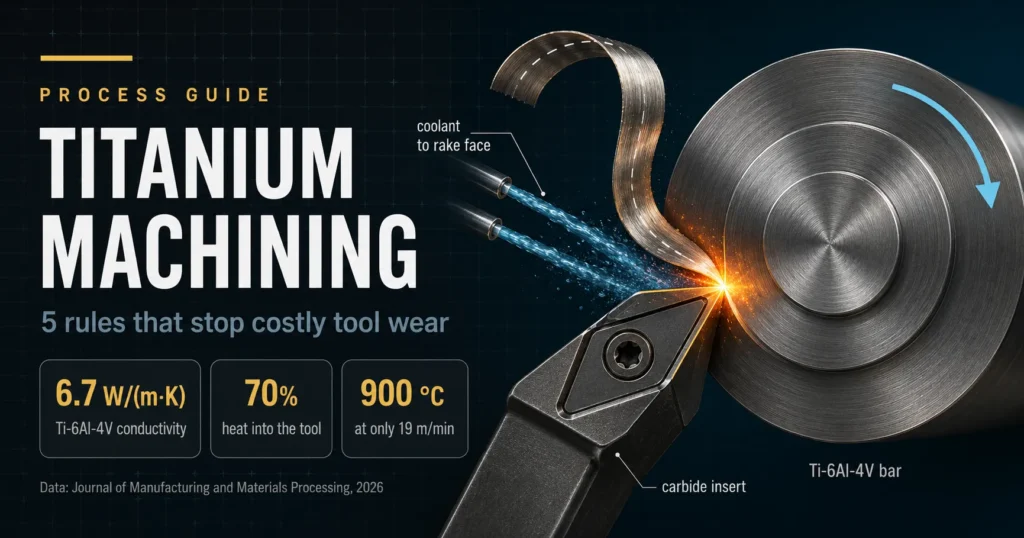
According to the 2026 report of the University of West Bohemia, the thermal conductivity of Ti-6Al-4V is only 6.7 W/(m· K), and the rake face temperature has exceeded 900°C at a cutting speed of 19 m/min.
Tool life is mainly affected by heat. Titanium alloy has poor thermal conductivity, and about 70% of the cutting heat enters the tool (40% for steel), which directly explains the failure of most blades. When the temperature exceeds 600 °C, tungsten (W) and cobalt (Co) diffuse into titanium, and the depth can reach 20μm at 800 °C, forming crater wear, rather than flank wear land (VB).
In addition, the elastic modulus of titanium alloy is about 100-130 GPa, which is only half of that of steel. The slender parts make the back of the tool rebound and hold the back of the tool face, causing chatter. This makes the rigidity of the whole machine more critical than the maximum speed of the spindle.
Rule 2: Set Titanium Machining Speeds and Feeds From Data
In a 2026 turning study, Ti-6Al-4V was machined at a cutting speed of 110 to 140 m/min, a feed per revolution of about 0.05 to 0.12 mm/r, and a depth of cut (ap) of 0.5 mm. The results show that the feed rate and cutting speed are the main factors affecting the tool wear volume, and the determination coefficient R² of the regression model is as high as 0.998.
| Opération | Starting window |
|---|---|
| Finish turning, uncoated submicron carbide | 110 to 140 m/min, 0.05 to 0.12 mm/rev, ap 0.5 mm |
| Turning with H13A carbide, zone to avoid | 70 to 75 m/min at 0.17 mm/rev |
| Dry high-speed side milling with ultrasonic assistance | 40 to 100 m/min, 0.01 to 0.02 mm/z |
The study also found that there is a strong interaction between feed rate and cutting speed, so they cannot be adjusted independently. At the same time, improving the wear acceleration effect caused by the two will exceed the sum of their respective individual effects.
Too low feed setting is a mistake that is easy to be ignored. Smaller feed will aggravate the ploughing and friction of the cutting edge, and friction will lead to work hardening: The milling test cited in this study shows that the microhardness of the machined surface layer is about 70% to 90% higher than that of the matrix material. The cutting thickness per revolution should be kept constant to avoid the tool idling friction in the cutting zone.
You also need to pay attention to the depth of cut. Under the same taux d'enlèvement de matière (MRR), the cutting temperature generated by increasing the amount of back cutting is lower than that of increasing the cutting speed or feed rate. For workshops that are selecting equipment for such conditions, you can refer to the rigidity checklist in JIANKE buyer’s guide for small shop CNC lathes.
Rule 3: Choosing Geometry Deliberately for Titanium CNC Machining
The clearance angle is the key parameter. An experiment in 2026 showed that there was a statistically significant interaction between the rear angle and the feed rate between 6°and 21°. The optimal rear angle changed with the mechanical load and had no fixed value. When the feed is large, a smaller back angle is needed to enhance the strength of the wedge, and when the feed is small, a larger back angle can reduce the friction of the flank. When the back angle is more than 21°, it is easy to break the blade.
The cutting edge radius (rn) is reduced from 40μm to 10μm, and the cutting force is reduced by about one-third. The sharp edge realizes cutting, and the blunt circle causes extrusion ploughing, which reduces the accuracy of titanium machining.
The recommended reference of indexable carbide insert is −5°rake angle with 5°rake angle. The fine grain and low cobalt grade are better than the coarse grain scheme. For applications with strict tolerances, see JIANKE’s Aerospace CNC Lathe Precision Guide.
Rule 4: Aim the Coolant, Then Worry About Volume
The cooling effect depends on the delivery position of the coolant, not the flow rate. A study shows that the ultrasonic vibration side milling of Ti-6Al-4V under dry high-speed conditions, compared with conventional milling, the residual compressive stress is increased by up to 79%, and the surface hardness is increased by 9.88% to 14.06%.
This finding shows that the core factor controlling thermal damage is the cutting mechanism itself, not just the cutting fluid. Intermittent cutting shortens the average time of tool-chip contact, thereby reducing the accumulation of heat at the interface.
When using large flow flood cooling, the injection target should be the rake face. The group of turning tests in 2026 specially produced a 3D printing guide nozzle, which accurately transported the emulsion with a concentration of 6.3% to the rake face. The researchers also listed “liquid supply from the flank direction” as the focus of the next stage of research.
The practical operation points of titanium machining are as follows: first adjust the nozzle position and then pressurize, measure the concentration with a refractometer, and use through-tool coolant for the deep surface that cannot be reached by external jetting. The comparison of the cooling capacity of the machine end can be seen in our guide to top-performing CNC metal lathes.
Rule 5: Manage Chips and Fire Risk Before the First Cut

Since December 6,2024, NFPA 660 “Standard for Combustible Dusts and Particulate Solids” has been integrated and replaced NFPA 484 as the main normative document for combustible metals in the United States. Titanium fines and powders, together with the other five standards, were included in the document.
Chips and grinding dust produced by titanium machining belong to Class D fire (metal fire), and water fire will aggravate the fire. Wet dust collection, strict on-site cleaning system, type D fire extinguisher beside the machine tool, and written dust hazard analysis (DHA) are the basic requirements under the new standard.
Controlling waste also has financial significance. The US Geological Survey (USGS) Mineral Commodity Summaries 2026 report shows that the United States does not produce any titanium sponge in 2025, the net import dependence is estimated to be 100%, the import volume of titanium sponge is about 44,000 metric tons, and most of the titanium metal flows to the aerospace field.
In the case of raw materials relying on imports and requiring batch-by-batch certification, a scrapped forging not only loses material, but also delays the delivery cycle. Therefore, conservative parameters should be used in the processing of the first article, and on-line measurement should be carried out during the process. When the structure of the part is allowed, the one-setup process should be adopted as far as possible.
QFP
The fundamental reason is that the thermal conductivity of titanium alloy is low. The thermal conductivity of Ti-6Al-4V is about 6.7 W/(m·K), which is only one-sixth of that of carbon steel, resulting in nearly 70% of the cutting heat entering the tool rather than being discharged with the chip.
The cutting speed of 110 to 140 m/min, the uncoated submicron cemented carbide blade and the depth of cut (ap) of 0.5 mm were used in the turning test. The earlier wear map study showed that the H13A grade had entered the accelerated wear zone when it was 70 to 75 m/min with 0.17 mm/r feed, which indicated that the machining state could not be fully judged only by the cutting speed.
Its influence depends on the level of feed. The feed rate is the single influencing factor of the largest wear volume; however, too light feed will lead to ploughing and work hardening, and the measured hardness of the machined surface is 70% to 90% higher than that of the matrix material. The goal is to keep the chip load constant per revolution.
It is feasible under the condition of process assistance. At the cutting speed of 40 to 100 m/min, dry high-speed side milling is realized by ultrasonic vibration, and the residual compressive stress is up to 79% higher than that of conventional milling. There is still a high risk of conventional dry cutting without auxiliary means.
Conclusion
If the cutting heat is used as the key control variable, the process of titanium machining will become predictable: the cutting speed is controlled within the verified range, the cutting thickness per revolution is kept stable, the coolant is accurately sprayed onto the rake face according to the appropriate back angle of the feed, and the chip is treated as a fire hazard rather than an ordinary waste. The common basis of these five rules is the rigidity of the machine tool, which is the value of the special Swiss type lathe of Jianke Machinery.