In modern manufacturing, a finishing process can determine whether your parts are just qualified or perfect. CNC grinding can achieve strict tolerances and achieve excellent surface finish, which is simply impossible for other machining methods.
After removing most of the material in the rough machining operation, the part is formed by CNC grinding and finishing in the last step of the machining process. Whether you are producing aviation turbine blades or medical implants, understanding CNC grinding and its differences from other CNC machining processes is critical to improving production efficiency.
What is CNC Grinding?
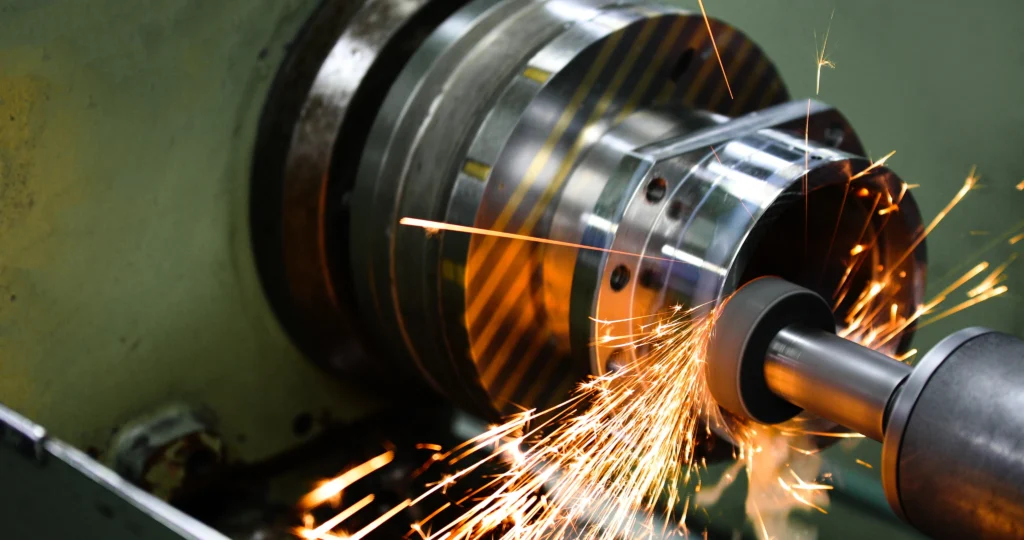
CNC grinding (Computer Numerical Control Grinding) is an advanced machining process that uses a rotating abrasive grinding wheel to remove material from the workpiece. Under the control of precision software, the machine tool performs micro-cutting and grinds metals, ceramics or cemented carbides to obtain a surface with accurate geometry and extremely smooth surface.
Unlike manual grinding, CNC grinding ensures:
- Reproducibility: Each of the 1,000 parts produced in batches is identical.
- Accuracy: ±0.0001 inches (2.5 microns) tolerance is standard.
- Complexity: Multi-axis machine tools can automatically generate complex contours.
CNC Grinding Equipment: What You Need to Know?
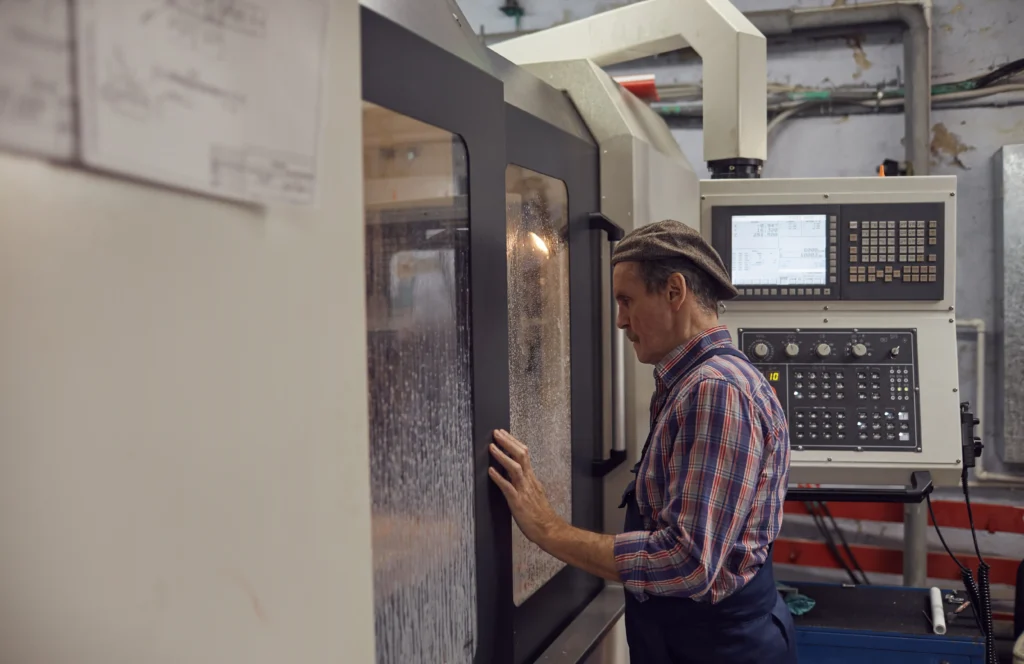
The quality of CNC grinding equipment can determine the accuracy of parts. A grinding unit is not just a machine – it is an integrated system coordinated by the various components.
Core Machine Structure
High-quality CNC grinding equipment requires extremely high rigidity. The machine tool base is usually made of polymer concrete or heavy cast iron to dampen vibration. Even small vibrations are transmitted to the workpiece that destroy the surface finish (this defect is called trembling).
Grinding Wheel
The grinding wheel is a cutting tool. It consists of abrasive particles (cutting edge) and binder.
Conventional Grinding Wheel: Alumina or silicon carbide.
Superabrasive Grinding Wheel: Diamond or CBN (Cubic Boron Nitride).
Jianke Machinery Notes: CBN grinding wheel is the first choice for CNC grinding hardened steel due to its thermal stability and wear resistance.
Coolant Filtration System
Grinding will produce fine metal powder (wear debris) and huge heat. An advanced high pressure cooling system is indispensable. It must not only cool the contact area to prevent metallographic damage, but also filter out the wear debris to prevent it from scratching the part during the next pass.
Dressing Spindles
Over time, the grinding wheel becomes blunt or clogged. Modern CNC grinding equipment usually includes an automatic dressing spindle for correcting the grinding wheel that exposes new abrasive particles and restores the geometric profile of the grinding wheel without operator intervention.
Comparison: CNC Grinding vs. CNC Lathe
A common question in machining is: If I already have a CNC lathe, why do I need a grinder?
Although CNC lathe (turning center) is very suitable for removing a large amount of materials from cylindrical parts, it has limitations in surface finish and hardness treatment. Hard turning (turning hardened steel on a lathe) is possible, but CNC grinding is superior in final finishing.
| Comparison Table: CNC Grinding vs. CNC Lathe | ||
|---|---|---|
| Feature | CNC Grinding | CNC Lathe (Turning) |
| Primary Function | Finishing & High Precision | Roughing & Shaping |
| Material Removal | Abrasive Wheel (Micro-cutting) | Single-point Insert (Shearing) |
| Best Material | Hardened Steel, Carbide, Ceramics (>60 HRC) | Soft to Medium Metals (<50 HRC) |
| Surface Finish (Ra) | < 0.2 um (Mirror finish) | 0.8 – 3.2 um (Visible tool marks) |
| Tolerance | Extremely Tight (Microns) | Standard (Thousandths) |
| Heat Generation | High (Requires flood coolant) | Moderate |
From the above table can be seen: The use of CNC lathe rapid prototyping parts ; CNC grinding is used to process the part to the final perfect size and surface quality.
Types of CNC Grinding Machines
CNC grinding has several different machine configurations, each designed for a specific geometry.
Cylindrical Grinders
Cylindrical grinders process the outside of cylindrical parts. The workpiece is clamped between the top tips or rotated in the chuck, while the grinding wheel removes the material. This is the CNC lathe direct finishing corresponding equipment.
Surface Grinders
Surface grinders are used to create flat and parallel surfaces. The reciprocating table moves the workpiece back and forth under the rotating grinding wheel. This is crucial for mold manufacturers.
Centerless Grinders
In this setting, the parts are not mechanically clamped. Centerless grinders are located between the grinding wheel and the guide wheel, which is supported by the plate. This allows the production of simple cylindrical parts such as pins and needle rollers at very high speeds.
5-Axis Tool and Cutter Grinders
The 5-axis tool and cutter grinders is a highly specialized machine for the manufacture or regrinding of milling cutters, drills and end mills. They can move grinding wheels along complex 3D paths to create spiral grooves and cutting edges.
Key Benefits of CNC Grinding Process
Processing Hard Materials: Once the parts are heat-treated (hardened), it is difficult to cut with a lathe or a milling machine. Grinding is usually the only way to adjust the size of hardened parts without damaging the tool.
Dimensional Accuracy: For parts that require interference fit (such as bearings for press-in shafts), grinding provides the necessary diameter control.
Surface Integrity: Grinding produces residual compressive stress (if operated correctly), which can actually improve the fatigue life of the component.
24/7 Automation: Modern CNC grinding equipment can be paired with a robot loader to achieve lights out manufacturing (unattended production).
Application of CNC Grinding Process
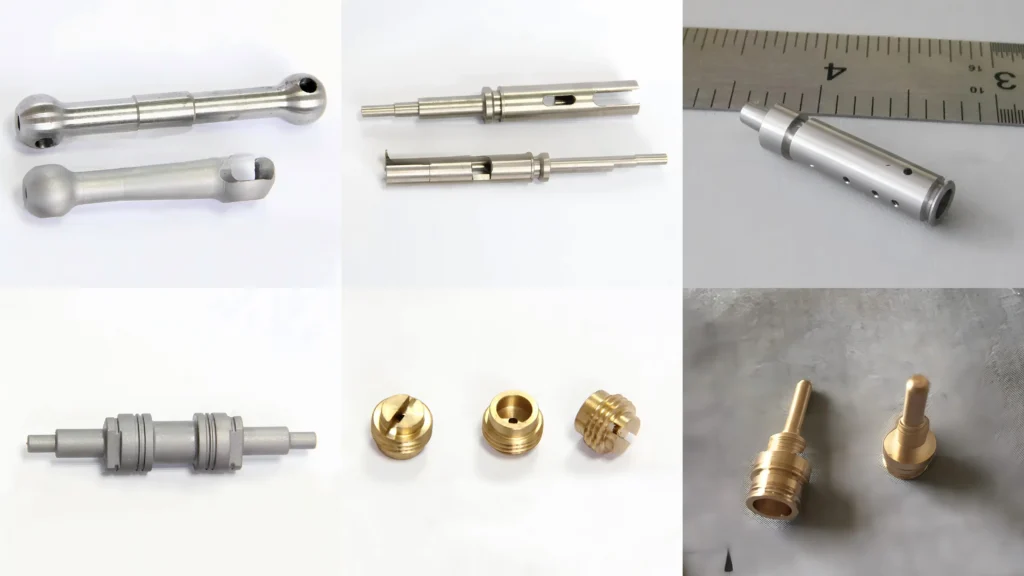
Automotive: Camshafts, crankshafts and gearbox gears need to be ground to ensure quiet operation and service life.
Aerospace: Turbine engine components made of special superalloys are ground to withstand extreme environments. Read more about Jianke’s capabilities in CNC Machining For Automotive Industry.
Semiconductor: Silicon wafers need to be ground to perfect flatness before processing.
Medical: Surgical tools and needles require burr-free, super-sharp edges that can only be provided by grinding.
Read more about Jianke’s capabilities in CNC Machining Services about Medical Devices.
The Best CNC Machine – Jianke CS-12-6 Dual Spindle Centering Machine
Jianke CS-12-6 dual spindle centering machine is a high-performance Swiss-type lathe designed to achieve excellent accuracy and multi-functional processing capacity. This advanced machine tool supports a variety of machining operations, including turning, milling, drilling, and grinding. All operations can be completed in one clamping, thereby minimizing errors and improving production efficiency.

It is particularly good at processing slender shafts with a diameter of less than 12 mm and complex and irregularly shaped parts, making it a valuable tool for high-demand industries such as medical devices and electronic components. Focusing on efficiency and accuracy, CS-12-6 can seamlessly integrate multiple processing steps, shorten the clamping time, and provide excellent processing results for complex parts, thereby improving the CNC grinding workflow.
Conclusion
CNC grinding is not only the finishing step, but also the key technology to determine the precision limit of modern manufacturing. Equipment such as CNC lathes are good at removing materials efficiently, and the grinding process plays a central role in ensuring the quality of parts.
Investing in high-precision CNC grinding equipment and understanding the details of the abrasive process can help the workshop meet the increasingly stringent regulatory requirements of the aerospace, medical and automotive industries. With the continuous tightening of parts tolerances and the continuous improvement of material hardness, the dependence on grinding technology will be further deepened.
For more technical details on abrasive processes, please visit the American Manufacturing Technology Association (AMT) or related standards bodies.
FAQ
Generally speaking, we can ‘t. Although the hard turning technology on CNC lathes has been improved, it cannot achieve the surface finish (Ra), roundness or cylindricity that CNC grinding can achieve, especially on materials with hardness exceeding 60 HRC.
In addition to the machine base itself, the control system (CNC) and high-precision spindle bearings are the most costly components. In addition, the consumable superabrasive grinding wheel (diamond / CBN) is also a huge continuous investment.
The choice depends on the workpiece material. Alumina is used for mild steel, silicon carbide is used for cast iron or non-ferrous metals, CBN is used for hardened steel, and diamond is used for cemented carbide and ceramics.
Smooth grinding (or no feed grinding) is the last process, and the grinding wheel traverses the part without any additional feed depth. It allows the elimination of elastic deformation or deflection in the machine to ensure that the parts are perfectly rounded and conform to the size.
In terms of material removal rate (MRR), it is slower than milling or turning. However, modern technologies such as Peel Grinding or Creep Feed Grinding have significantly increased the speed, making them suitable not only for finishing but also for the production environment.