Has your CNC lathe have any abnormal performance recently? Have you noticed the strange ticks in their output or the way the machine behaves ?
If so, you come to the right place. We will discuss some of the most common problems in CNC lathes and how to solve them.
However, before we start, let ‘s make sure we all understand the basic principles of CNC lathes.
What Is a CNC Lathe Machine?

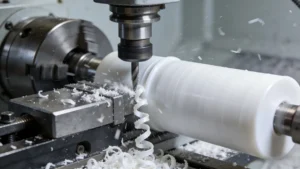
CNC lathe is a complex machine tool designed for precision CNC turning and manufacturing through computer numerical control ( CNC ).
It is the embodiment of technological evolution. It combines the ancient principles of lathes with advanced computer programming to achieve unprecedented machining accuracy and efficiency.
CNC lathes have completely changed the way materials are made, making them an indispensable tool for all walks of life and many machine tool workshops. It can perform complex cutting and forming with extremely high precision, making it the cornerstone of modern manufacturing processes. Whether it ‘s metal, plastic or wood, CNC lathes offer unparalleled versatility in handling a wide range of materials.
| Table of Manual Lathe VS CNC Lathe | ||
|---|---|---|
| Feature | Manual Lathe | CNC Lathe |
| Operation | Manual control via handwheel, relying on the worker’s feel. | Computer programming (G-code) automatic control |
| Machining accuracy | Generally (greatly influenced by operator) | Extremely high precision: micron-level accuracy and excellent consistency |
| Production efficiency | Low: Suitable for single items and simple repairs. | High efficiency: suitable for large-volume and continuous production |
| Complex parts capabilities | Limited, making it difficult to process complex curved surfaces. | Extremely powerful: easily handles complex geometric shapes |
| Reliance on operator | High: Requires experienced senior operators. | Low labor cost: one operator can supervise multiple machines |
How Does CNC Lathe Machining Work?
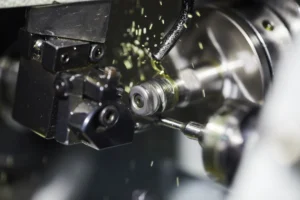
The engineer converts the design drawings into a digital program ( G code ). After the computer system reads the program, the tool is automatically controlled to move according to the set path, and the high-speed rotating workpiece is accurately cut, and finally processed into a predetermined part.
Top 10 Common CNC Lathe Machine Failures
CNC Spindle Problem
The spindle is the core of any CNC machine tool and is responsible for driving tools and cutting materials. Common CNC spindle problems include overheating, vibration and noise, which may be due to bearing failure, improper lubrication or misalignment.
Troubleshooting :
- Check the lubrication regularly to ensure that the spindle bearing is in good condition.
- Align the spindle according to the manufacturer ‘s recommendations to avoid vibration.
- Regular maintenance and replacement of bearings as needed to avoid more serious failures.
CNC Tool Fracture
Tool fracture is a common problem in CNC machining, which may lead to production stoppage. This may be due to excessive tool wear, incorrect tool path, improper tool selection or improper feed rate.
Troubleshooting :
- Use the right tool for machining materials and ensure that the tool is sharp.
- Adjust the feed rate and cutting speed according to the material specifications.
- Regularly check whether the tool is worn and replace it in time.
Numerical Control Overheating Solution
Overheating is a common problem in CNC lathes especially in mass production environments. Overheating can cause machine downtime, component damage and reduced accuracy.
To eliminate CNC overheating solutions :
- Ensure that the coolant flow is normal to keep the machine temperature in the best range.
- Regularly monitor fan and cooling system operation to avoid heat build-up.
- Keep the environment clean because dust and debris can cause poor ventilation and overheating.
Programming Error
CNC programming errors may lead to tool path errors, machine tool failures or poor workpiece quality. These problems are usually caused by G code errors or parameter setting errors.
Troubleshooting :
- Before running any program, be sure to carefully check the G code.
- Use simulation software to test programs and identify errors before formal production.
- Train operators try to minimize programming errors and encourage correct verification procedures.
Vibration of CNC Lathe
Excessive vibration during CNC machining may lead to poor surface treatment, shorten tool life and cause CNC lathe failure over time. Vibration is usually caused by tool imbalance, spindle misalignment or mechanical parts loosening.
CNC lathe vibration troubleshooting :
- Balancing tools to ensure that they are correctly mounted on the spindle.
- Check spindle alignment and tighten any loose parts.
- If sustained vibration is detected, damping materials or systems should be used.

Poor Surface Treatment
Rough or uneven surface treatment may be due to tool passivation, incorrect cutting speed or excessive tool vibration during the process. The instability of material quality will also affect.
Troubleshooting :
- Make sure that the tool is sharp, blunt on the replacement.
- Adjust the cutting speed and feed to optimize the surface.
- Firmly fix the workpiece to reduce vibration and shaking during cutting.
CNC Axis Positioning Problem
The shaft positioning error may lead to cutting misalignment and workpiece non-conformity. These problems are usually caused by encoder failure, ball screw wear or improper machine calibration.
Troubleshooting :
- Calibrate the machine on a regular basis to ensure accurate shaft movement.
- Check and replace worn ball screws and faulty encoders.
- Keep the machine guide rail clean and lubricated to avoid resistance.
Electrical Problems in CNC Lathes
Electrical failure may interrupt operation, usually due to wiring failure, poor grounding or fuse burning. The power surge can also cause CNC lathe failure and damage sensitive components.
Troubleshooting :
- Check the machine ‘s lines for signs of wear or damage and replace any faulty connections.
- Use a surge protector to prevent electric shock damage.
- Check whether there is a fuse and replace it if necessary.
CNC Lathe Overload
Pushing the CNC lathe beyond the operating limit may lead to CNC lathe failure such as motor burning, tool damage or overheating.
Troubleshooting :
- Always follow the machine recommended speed, feed rate and material thickness requirements.
- Avoid using the machine for a long time and do not let it cool.
- Implement a load monitoring system to detect whether the machine is close to overload.
Fault Sensors and Probes
Many CNC machine tools rely on sensors and probes to monitor positioning, tool replacement and other key components. When these sensors fail, it may lead to inaccurate readings, which in turn leads to processing errors.
Troubleshooting :
- Regularly check the accuracy and functionality of the sensors and probes.
- Any fault or faulty sensor should be replaced in time.
- Ensure that the machine software is configured correctly and can communicate with the sensor.
It is hoped that according to these instructions, you can better understand your CNC lathes so as to better clean, maintain and maintain them. In this way, you are more likely to prevent problems and know how to identify problems.
Read also This Article:
Top-Performing CNC Metal Lathes : A Buyer ‘s Guide
Avoid Common CNC Machine Issues With JIANKE

Various factors can cause simple machining problems to escalate into more challenging situations. JIANKE is well aware of the importance of balancing quality and efficiency, so it provides CNC machine solutions that are most suitable for each customer and after-sales to ensure that your machine maintains the best performance. Feel free to contact us immediately.
FAQ
Cutting taper is often caused by improper length-diameter ratio of workpiece, tool passivation or guide rail fouling. It is recommended to clean the guide rail and slide, check for chips or burrs, and re-align. If the problem persists, it may be bearing wear.
The physical life of a CNC lathe can usually reach more than 10 years, but the years of maintaining good machining accuracy and economy are affected by multiple factors, and the general reference range is 5 to 10 years.
We should not only focus on brand awareness or price, but also pay attention to the balance of ‘ technology matching, service responsiveness and market reputation ‘.
This depends on your business type, order size and long-term planning. If it mainly undertakes single, very small and simple maintenance parts, the initial cost of manual lathe is low and more flexible. However, if the business involves small batch orders, complex contour parts, or high-precision consistency requirements, investing in a CNC lathe can significantly enhance competitiveness.
The two difficulties are different. For newcomers to systematic learning, mastering the standard CNC operation process may be easier to get started than mastering the technology of manual lathes.