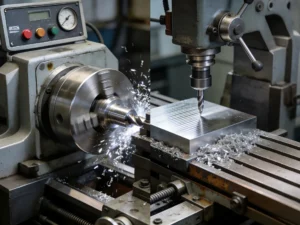
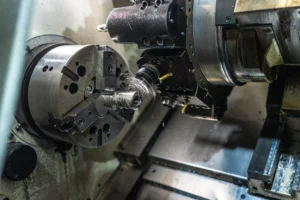
Turning is a foundational machining operation used to shape cylindrical parts by removing material with a cutting tool. Among turning techniques, longitudinal turning and transverse turning are the most common. Their differences is critical for selecting the right method based on part geometry, material, and surface finish requirements.
The correct choice directly impacts production efficiency, tool life, and final part quality, making this knowledge vital for engineers and shop floor operators. By mastering these techniques, you can improve precision and reduce machining time, ensuring consistent, high-quality outputs.
Longitudinal Turning Basic Principles
In longitudinal turning, the cutting tool moves parallel to the workpiece’s rotational axis. This technique is ideal for long cylindrical parts, enabling features such as grooves, shoulders, and threads.
For Example, machining a 500 mm automotive shaft requires longitudinal turning to maintain a uniform diameter along its length. This reduces the necessity for frequent reconfiguration and guarantees a uniform finish.
Transverse Turning Basic Principles
In transverse turning, the tool’s path is perpendicular to the axis of rotation of the workpiece. It is primarily used for end faces and flat surfaces, allowing the creation of shoulders, slots, and other radial features.
Producing the end face of a steel disc for a flange requires transverse turning to achieve a precise, flat surface suitable for assembly.
Applications
Longitudinal Turning Applications
- Shafts and Axles: Common in automotive, industrial machinery, and robotics.
- Tubes and Sleeves: Used in hydraulic, pneumatic, and structural components.
- Threads and Grooves: Internal and external threads can be created efficiently.
Start with a short test piece to set feed rates and depth of cut before machining full-length parts to ensure uniform results.
Transverse Turning Applications
- End Faces of Shafts: Essential for flat mating surfaces.
- Flanges and Discs: Used in industrial and pipe-fitting components.
- Slotting and Grooving: Ideal for keyways and radial features.
Use light feed rates and a facing pass to minimize chatter and produce a smooth surface when machining end faces.
Advantages and Challenges
Longitudinal Turning
Advantages:
- High Efficiency: Continuous cutting along the axis reduces idle time.
- Consistent Surfaces: Maintains uniform diameter along the workpiece.
- Fewer Setups: Ideal for long shafts and deep grooves.
Challenges:
- Chip Management: Chips can accumulate in deep grooves, affecting surface quality.
- Tool Wear: Continuous axial cutting can accelerate wear, requiring frequent inspection or replacement.
So you can use chip breakers and high-pressure coolant to maintain surface quality and extend tool life.
Transverse Turning
Advantages:
- Superior Surface Finish: Produces smooth, flat end faces and shoulders.
- Versatility: Suitable for a variety of radial features and slots.
Challenges:
- Limited Cut Depth: Not optimal for deep axial features.
- Setup Complexity: Some radial features require precise alignment or custom fixtures.
Machining a flange for a hydraulic pump with transverse turning ensures smooth, accurate surfaces, guaranteeing proper assembly and sealing.
| Feature | Longitudinal Turning | Transverse Turning |
| Feed Direction | Parallel to workpiece axis | Perpendicular to workpiece axis |
| Ideal for | Long shafts, tubes, grooves | End faces, flanges, slots |
| Surface Finish | Good, may require finishing | Excellent, smooth flat surfaces |
| Chip Evacuation | May accumulate, requires attention | Easier to evacuate |
| Tool Wear | Higher due to continuous cutting | Lower, intermittent cuts |
| Setup Complexity | Simple for long parts | Can be complex for certain geometries |
For a 500 mm steel shaft, longitudinal turning ensures uniform diameters and faster production, while transverse turning is better suited for facing and keyway features.
Conclusion
Longitudinal and transverse turning each offer distinct advantages.Longitudinal turning is optimal for the efficient and uniform removal of material from lengthy components, whereas transverse turning is preferred for achieving high-precision finishes on end faces and features in the radial direction.
Selecting the right technique depends on part geometry, material, and production goals. To know these differences allows you to optimize cutting parameters, reduce tool wear, and enhance overall part quality, making both methods indispensable in modern machining operations.