CNC turning is not only often used in high-strength metals such as steel and titanium, but also very important for the manufacture of high-precision plastic parts. Whether it is to make prototypes for new medical equipment or mass production of aerospace seals, mastering the fine process of non-metallic material processing is the key.
What is Plastic CNC Turning?
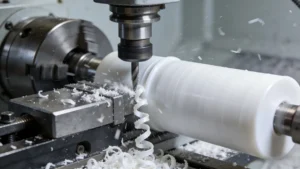
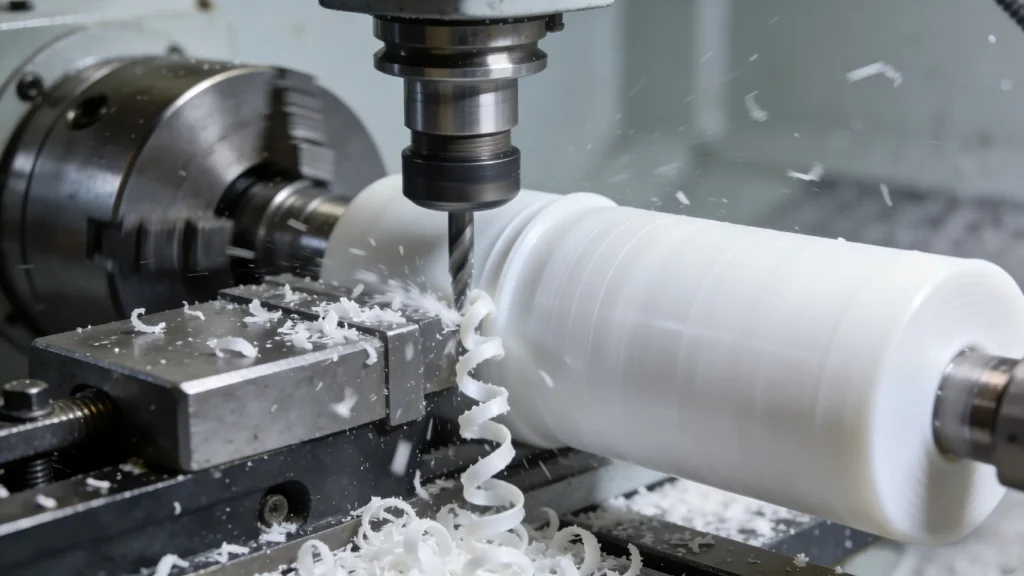
Plastic CNC turning is a kind of material reduction manufacturing process. This process typically involves high-speed rotation of plastic workpieces (mostly bars) while removing the material through a fixed cutting tool to form the part. Different from the milling process of tool rotation, turning is very suitable for manufacturing cylindrical parts with internal and external characteristics.
In this process, the processing differences between plastic and metal are mainly reflected in the following aspects:
- Thermal Expansion: Plastics expand rapidly when heated.
- Workpiece Deformation: plastic material is soft, easy to bend under the pressure of the tool.
- Chip Morphology: Plastics usually produce continuous banded chips, which are not as easy to break as metal chips.
Why CNC Turning instead of Injection Molding?
The common problem in the manufacturing industry is: why use CNC machining when injection molding exists?
Although injection molding has advantages in small batch production (over 10,000 pieces), CNC turning has unique advantages in specific scenarios:
- No Mold Cost: You do not need expensive mold that is very suitable for prototype production.
- Design Flexibility: You can change the design immediately by updating the code.
- Rigorous Tolerances: High-end CNC lathes can maintain tolerances of +/- 0.001 inches, which is difficult to achieve for injection molding where shrinkage makes it difficult to control dimensions.
- Material Integrity: Machined parts are cut from solid bars and structural integrity is generally superior to injection molded parts that may have flow marks or voids.
Comparison of Common Plastics Suitable for CNC Turning
Choosing the right material is the first step in successful CNC turning. Different plastics require different cutting speeds and tool strategies. The following is a structured comparison of commonly used processed plastics.
| Comparison Table of CNC Turning Plastic Material | |||
|---|---|---|---|
| Material | Commercial Name | Machinability | Best Application |
| Acetal | Delrin | Excellent | Gears, bushings, electrical insulators. |
| Nylon | Nylon 6/6 | Good | Bearings, wear pads, wheels. |
| PTFE | Teflon | Moderate | Seals, chemical resistant parts. |
| PEEK | PEEK | Good | High-temp aerospace & medical implants. |
| Acrylic | Plexiglass | Moderate | Optical components, transparent manifolds. |
| Polycarbonate | Lexan | Good | Impact-resistant covers, lenses. |
Acetal (Delrin)
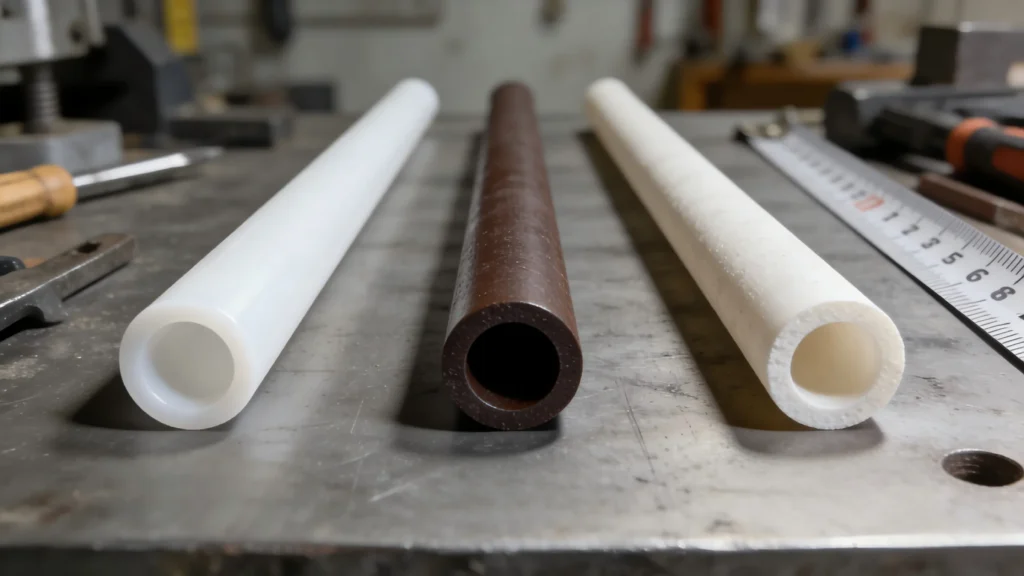
Acetaldehyde is widely considered to be the easiest plastic to process and is an ideal choice for manufacturing high-rigidity precision parts. Because of its stable size, low hygroscopicity, and easy chip breakage, it can prevent the nest shaped chip problem common in CNC turning.
PEEK (Polyetheretherketone)
PEEK is a high-performance engineering thermoplastic. Although it is expensive, it has excellent chemical resistance and heat resistance. When CNC turns PEEK, a sharp tool is needed to prevent heat accumulation, otherwise it will lead to stress cracking of the material.
PTFE (Teflon)
PTFE is very suitable for making seals because of its soft and slippery texture, but it is difficult to maintain tolerance because of its easy compression. The machinist must use a lighter clamping force to avoid deformation of the part during the turning operation.
How to Optimize Plastic CNC Turning?
You have to adjust the processing parameters in order to achieve a perfect part: plastic cannot be processed like aluminum or steel.
Tool Selection
Positive Rake Angles: Use the geometry of a large positive rake angle to cut the plastic instead of scraping it, which reduces heat generation.
Polished Flutes: For materials such as acrylic and polycarbonate, polished tool grooves help to quickly remove chips and improve surface finish.
Tool Material: Carbide inserts are standard, but for abrasive plastics (such as glass fiber nylon), it is recommended to use polycrystalline diamond(raw material always is PCD) tools to extend tool life.
Speeds and Feeds
One of the biggest mistakes in CNC turning plastics is that the spindle speed is too fast, but the feed rate is not enough.
High Feed Rate: If the feed is too slow, the tool stays at one point that causes friction and melting the plastic.
Speed Control: Although plastics can be processed at high speed, the centrifugal force generated by excessive rotational speed (RPM) may deform longer parts.
Cooling Strategy
Flood Coolant: This is usually recommended to wash away chips and keep parts cool.
Air Blast: For some plastics such as nylon, the water-based coolant may be absorbed, thus slightly changing the size. Compressed cold air is the first choice to remove chips in this case.
Common Challenges and Solutions
You may encounter specific defects in CNC turning of non-metallic materials. The following is a FAQ provided in the form of a question and answer.
This is usually caused by friction. Your tool may be blunt, or the Dwell time may be too long. The solution is to increase the feed rate (chip load) and ensure that sharp polishing tools designed for plastics are used to reduce heat build-up.
The long strip chips of plastic are easy to wind on the tool and parts, scratch the surface and even damage the tool. To solve this problem, you can use the ‘ Peck Turning ‘ cycle to break chips, or choose a material with better natural chip breaking performance like Delrin.
Vibration or tremor is the main reason. It should be ensured that the workpiece is firmly clamped (and not pressed), and the amount of tool overhang should be minimized. For transparent plastics (e.g., acrylic), the use of final finishing tools (removal of a very small amount of material, e.g., 0.05 mm) can significantly restore their transparency.
Plastics have a high coefficient of thermal expansion (more than 10 times higher than steel), and some materials (such as nylon) are easy to absorb moisture. Processing heat will lead to expansion and contraction after cooling. The solution is: measurement in a constant temperature environment; for high-precision parts, stress release is carried out for 24 hours after rough machining, and then finishing is carried out.
Industry Applications of Turned Plastics

CNC turning is essential in every high-tech field:
- Medical: PEEK implants and surgical tool handles require biocompatibility and extremely high precision.
- Aerospace: PTFE seals and nylon conduits are widely used due to their lightweight and flame retardant properties.
- Food Processing: UHMW-PE (ultra-high molecular weight polyethylene) rollers and guide rails are processed by turning because the material is non-toxic and self-lubricating.
- Electronics: Delrin insulator is used for switching equipment components that require a conductivity of zero.
5 Principles of Design for Manufacturing (DFM)
In order to reduce costs and improve quality when ordering CNC turning services, please follow the following design rules:
- Avoid Sharp Inner Angles: Like milling, the tool is rounded. A small radius is reserved at the inner corner to reduce stress concentration.
- Restricting Deep Holes: Due to the difficulty of chip removal, it is difficult to drill deep holes on plastics. Try to keep the hole depth less than 3 times the diameter.
- Note Wall Thickness: Thin walls (less than 0.5mm) may vibrate during turning or warp after removal from the chuck.
- Specify Tolerances Wisely: Do not require +/-0.0005’’ tolerances unless absolutely necessary. The plastic will move with the change of temperature; too tight tolerances will significantly increase costs.
- Standardized Threads: Try to use standard thick thread (UNC/ISO), as fine thread is easier to slip in softer plastic.
Conclusion
Mastering the CNC turning of plastics requires changing the way of thinking of metal processing. It requires sharp knives, aggressive feed rates to prevent melting, and a deep understanding of material science. By selecting the right plastics – whether for general purpose Delrin or PEEK for high stress environments – and following the above optimization guidelines, you can produce durable, high-precision non-metallic components.
For more information about material properties, you can visit MatWeb, which is a comprehensive material data table database.
If you want to expand your manufacturing knowledge, check out our guide on CNC Milling and vs. Turning or exploring CNC Turning Metal Material Processing.