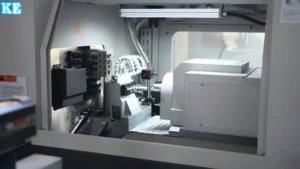
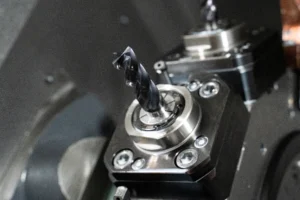
The correct processing method directly determines the cost-effectiveness and product quality in precision manufacturing. CNC milling and turning, as two of the most common subtractive manufacturing technologies, play a central role in modern industry. Although both processes use Computer Numerical Control ( CNC ) to remove materials and shape complex parts, they operate based on very different mechanical principles.
This article will detail the operation mechanism, respective advantages and ideal application scenarios of the two processes to ensure that you can make the most informed decisions for production needs.
What Are CNC Milling and Turning?
To determine which process is suitable for your project, you must first define what these technologies are and how they process raw materials.
What is CNC Milling?
CNC milling is a machining process characterized by the workpiece remaining stationary (clamped on the table), while the high-speed rotating cutting tool moves on the surface of the workpiece to remove the material. Milling tools can usually move along multiple axes (usually 3-axis, 4-axis, or 5-axis), so that complex shapes, holes, and slots can be carved from different angles.
Key Features of Milling:
- Tool Action: The tool rotates ; the workpiece is fixed.
- Geometric Shape: Suitable for square, plane or asymmetric shape.
- Versatility: Can handle complex 3D surface contours.
What is CNC Turning?
CNC turning usually takes place on machines known as lathes. In this process, the workpiece (usually a cylindrical bar) is clamped in the chuck and rotated at high speed. Then, the fixed cutting tool feeds to the rotating workpiece to ‘ cut ‘ the material.
Key Features of Turning:
- Tool Action: The workpiece rotates ; the tool is fixed.
- Geometric Shape: Suitable for cylindrical, conical or circular parts.
- Speed: For circular parts, it is usually faster than milling.
CNC Milling and Turning: Key Differences Explained
We can intuitively understand the difference between the two by comparing them side by side. The following table shows the comparison of CNC milling and turning in operation mechanism.
| Comparable Table:CNC Milling and Turning | ||
|---|---|---|
| Feature | CNC Milling | CNC Turning (Lathes) |
| Motion Primary | Cutting tool rotates | Workpiece rotates |
| Workpiece Shape | Rectangular, flat, or complex 3D | Cylindrical or tubular |
| Cutting Mechanism | Multi-point cutting tools | Single-point cutting tools |
| Common Operations | Slotting, drilling, facing, pocketing | Tapering, threading, knurling |
| Cost Factor | Higher setup time for complex geometries | Faster/cheaper for round parts |
When evaluating CNC milling and turning, the main determinant is usually the shape of the part. If it is round, use turning; if it is square or irregular, use milling.
Why Choose CNC Milling?
CNC milling is the preferred method for parts with extremely high geometric shape requirements.
Complex Shapes and Surface Profiles
If your design contains complex patterns, carvings or organic surfaces such as automotive molds or impellers, milling must be used. The 5-axis milling machine can approach the workpiece from almost any direction, creating a shape that the standard lathe cannot achieve.
Diversified Feature Processing
Milling is good at creating non-concentric features. This includes:
- Eccentric hole
- Pockets and slots
- A plane on a non-circular part
Production Flexibility
Modern milling centers are usually equipped with automatic tool changer (ATC), which can accommodate more than 30 tools. This allows a single machine to complete face milling, drilling, tapping and contouring in one clamping without manual intervention.
Why Choose CNC Turning?
Although milling functions are diverse, turning is well-deserved in the processing efficiency of rotating parts.
Excellent Surface Finish of Cylindrical Parts
Because of the continuous rotation of the workpiece, turning can produce very smooth and uniform surface finish on circular parts. To achieve a similar finish on a milling machine, complex tool paths are required and take longer.
High Speed Production
For simple shafts, pins, bolts or bushings, CNC milling and turning are not equal competitors – turning wins easily. The lathe can turn out the diameter of the shaft in a few seconds, while the milling machine must slowly cut along the circumferential trajectory.
Cost-effective for Round Raw Materials
If your raw material is a round bar, the waste generated by turning is less, and the material utilization rate is higher than the practice of milling the square into a circle.
Learn more about the history and mechanics of the Lathe on Wikipedia.
The Hybrid Solution: CNC Mill-Turn Center
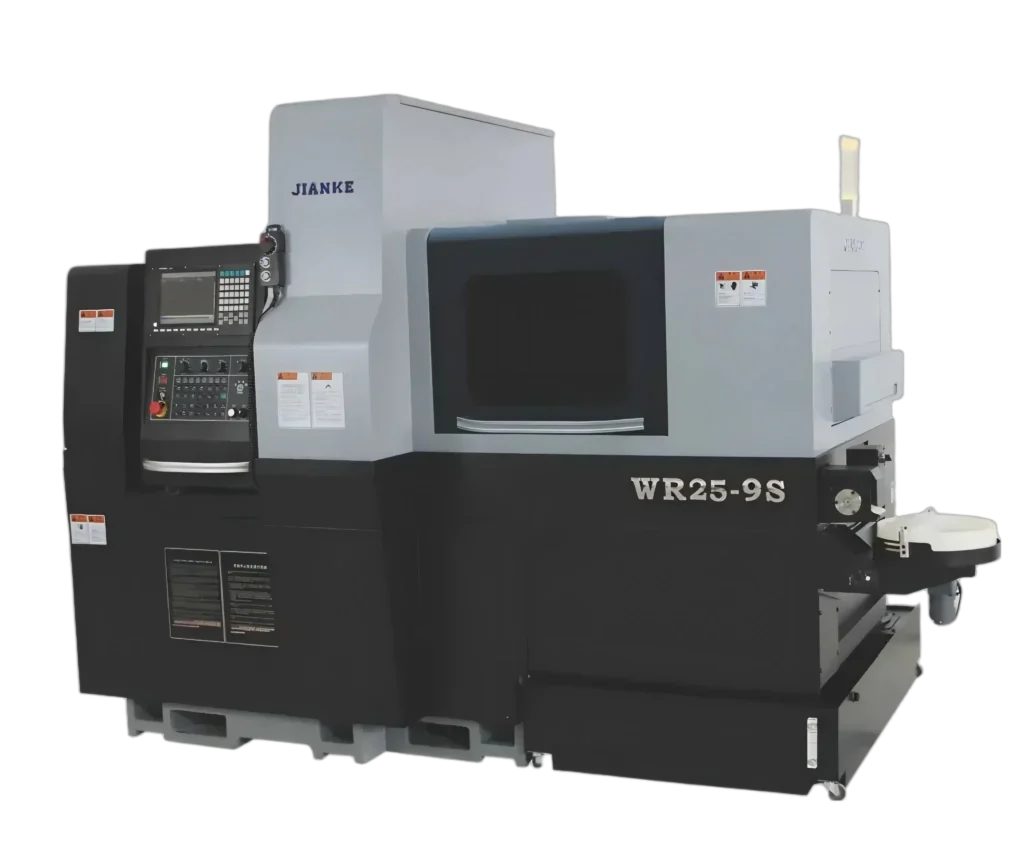
The boundary between CNC milling and turning is becoming blurred in modern manufacturing. Advanced machines, known as ‘Mill-Turn Centers’ or ‘Live-Tooling Lathes’, combine these two capabilities.
How Does a Mill-Turn Center Work?
These machines use chucks to clamp workpieces for rotary turning like lathes. However, they are also equipped with ‘live tools’—rotating milling cutters—that can perform drilling, tapping, and milling while the workpiece is stopped or moving slowly.
Benefits of Mill-Turn Center:
- One-time Forming: The parts can be completely processed in one clamping.
- Higher Precision: No need to move parts from lathes to milling machines that reduce human error.
- Efficiency: Significantly shorten the total processing cycle.
Cost Analysis: Milling vs. Turning
When budgeting for CNC milling and turning, consider the following factors:
- Setup Costs: Milling usually requires custom fixtures (vise, soft claw) to fix irregular shapes. Turning usually uses standard chuck claws, and the setting speed is faster.
- Running Time: For circular parts, turning speed is 2 to 5 times faster than milling. For square parts, milling is the only feasible choice.
- Tooling: Milling tools (end mills) are often more expensive and wear faster than single-point turning inserts.
If you are looking for internal pricing guidance, please contact us to obtain a pricing plan for CNC machining services.
How to Make the Final Decision?
Making a decision between CNC milling and turning ultimately comes down to the geometry and yield of the part.
Use CNC Turning: if your part is cylindrical, disc or tubular.
Use CNC Milling: if your part is square, plate or has complex non-concentric features.
Use a Mill-Turn Center: If your part is cylindrical, but requires complex side holes and slots.
By understanding the respective advantages of CNC milling and turning, you can optimize your design for manufacturability (DFM), reduce costs, and ensure that your parts meet the highest precision standards.
If you are ready to start your project, please contact our engineering team to discuss the best solution for your specific needs. We focus on providing high-precision customized processing solutions for your industry.
FAQ
CNC turning is usually more suitable for machining external threads on bolts or shafts because it can quickly produce extremely neat and high-strength threads. However, CNC milling is often used for ‘ thread milling ‘ inside large holes or for processing threads on non-rotating parts.
Technically, CNC milling machines can create cylindrical shapes using a process called ‘screw interpolation’. However, this method is much slower, and the surface finish is usually not as good as the effect of lathe processing.
These two processes are widely used in :
Aerospace : landing gear components ( turning ) and engine casing ( milling ).
Medical : bone nails ( turning ) and implants ( milling ).
Automobile : Piston ( turning ) and engine block ( milling ).
For cylindrical or circular parts, CNC turning costs are lower because the process is faster and the mold required is simpler. However, for non-cylindrical parts that require square features, CNC milling is more cost-effective. The ‘ cheaper ‘ solution always depends on the geometry of your part.