Accuracy and precision dominate, and CNC machine tool services can be used to collect information from machines in today ‘s manufacturing industry. Therefore, they have made key contributions to cutting-edge technology. Obviously, no feature of this deep integration between technology and medicine is more significant than the impeccable precision in the manufacture of medical devices, which can determine life and death.
CNC machine tool service shows the combination of comprehensive engineering and automation technology. The impact on the production of medical devices is almost unimaginable. This article describes in detail how CNC machining has become one of the main tools to meet the strict requirements of the medical industry.
Introduction to CNC Machining in Medical Device Manufacturing
CNC machining technology is actually the source of innovation in the complex field of medical device manufacturing, and accuracy, reliability and biocompatibility are all key features.
Accuracy and precision are essential for identifying the health effects of air pollution. In the manufacture of medical devices, accuracy and accuracy are far ahead. Every piece of equipment that goes in is subject to a rigorous approval process that adheres to strict patient care and overall performance standards.
These major deviations often lead to serious failures and significant damage. In surgical practice, these methods must be accurate and avoid errors during surgery. On the other hand, the manufacture of implantable devices relies on careful fabrication to minimize postoperative complications.
This is where precision engineering plays a role in medical diagnostic and therapeutic devices that also contribute to test results and treatment outcomes. Joint service authorities do not allow failure to meet quality standards and safety requirements, which can lead to product corrections and legal issues.
The Evolution of Medical Device Manufacturing
The early history of CNC machine tools can be traced back to the late 1940 s and early 1950 s. The first batch of CNC machines is the progress of machine tool automation. The concept of NC machine tools first appeared as a way of automated machine tools. It achieves this by using perforated paper tape as a means of control.
Compared with manual work, CNC machine tools provide higher accuracy and repeatability. The progress of computer technology has promoted the wide application of CNC machine tools.
By the 1970s, CNC machine tools became more popular and affordable. This has led to an increase in their use in small and medium-sized manufacturing enterprises.

Key Benefits of CNC Machining for Medical Devices
The advantages of using CNC machining services are not limited to precision, even if CNC machining parts are necessary for the operation of medical equipment. They provide enterprises with strategic manufacturing advantages to support their continuous innovation, compliance and competitiveness.
CNC machining has been proven to be very effective in the medical field :
Portable and Flexible CAD File
Product designers and medical experts can quickly exchange digital CAD data to support CNC turning medical parts. This technology significantly improves the ability of CNC machining to produce high-quality medical equipment at the time and place where it is most needed.
Faster Time to Market
Medical manufacturers can meet the deadlines for new product releases or emergency medical supplies. CNC machining is used for manufacturing and prototyping.
Cost-effectiveness in Production
CNC machining reduces manufacturing costs through fast cycles, repeatable quality and minimal material waste, especially when there are a large number of standardized components.
Precise and Repeatable Results
The ability of CNC lathes to manufacture parts with extremely high accuracy and precision is crucial. Each part produced by the machine is consistent and meets the required standards when the process can be accurately replicated.
Higher Design Flexibility
CNC machining can produce challenging shapes and complex geometries that cannot be achieved by traditional production techniques.
Quality Improvement
CNC machining parts have accuracy and consistency and can produce high-quality final products. Precise control of the machining process is essential to ensure that the finished product meets all tolerances and standards for medical parts and products.
Enhanced Security
Due to the elimination of human labor by CNC precision machining, the possibility of accidents or injuries at work is lower. In addition, the automation of the processing process reduces the possibility of human error and improves the safety and quality of the final product.
One-stop Function
Modern CNC turning centers usually integrate drilling, tapping, milling and turning. This ensures the alignment of features and shortens the processing time.
Extensibility from Prototype to Production
Whether you want 100,000 units or 10 unique prototypes, you can effectively achieve CNC machining without sacrificing accuracy.

What Materials Are Used?
Any medical component must be considered for sterilization or treatment, with specific tension and ductility requirements. The materials available to the industry reflect this. About four-fifths of medical devices are made of stainless steel because of their oxidation resistance and ease of processing.
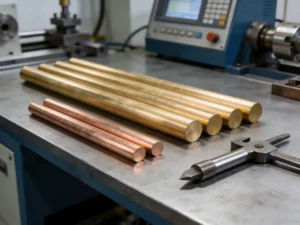
However, titanium alloys are rapidly becoming more and more popular because the elasticity of titanium is closer to the bone than stainless steel. Some ceramics, polymers and composites are also used. More material research is being carried out every day.
CNC Machining in Medical Devices
The following are different processing technologies in medical device manufacturing :
| Tables of Different Processing | |
|---|---|
| CNC Machining Operation | Description |
| Lathe Operation | Workpiece rotation with linear tool movement, creating helical cutting paths. |
| Boring | Internal surface cutting technique is essential for producing cannulated surgical instruments. |
| Facing | Precise cutting of perpendicular faces to form critical mating surfaces. |
| Multi-axis Control | Simultaneous control of multiple axes to produce intricate and complex shapes. |
Milling and Turning Operations
Milling and turning are two key numerical control operations in the production of medical devices. Milling separates materials from parts by rotating cutting tools to form complex shapes, features and contours. This medical technology is commonly used in projects to manufacture implants, surgical instruments and external prostheses with high precision and complex shapes.
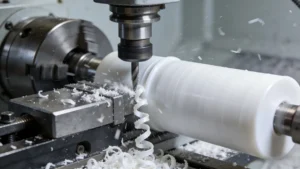
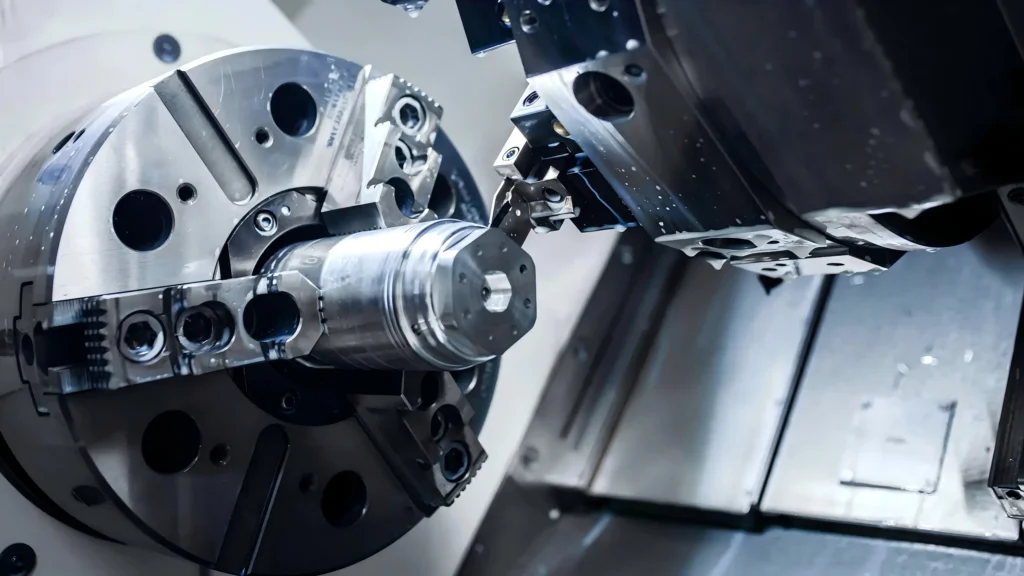
CNC turning uses machine tool cutting tools to rotate the workpiece. It shapes it into a cylindrical or conical shape, while the broken ship relies on the tension generated by the working material itself. This is the most suitable tool for manufacturing cylindrical parts.
As a result, through simultaneous milling and turning, manufacturers are able to manufacture numerous medical devices in accordance with precise standards and efficiently. This helps to meet the needs of various groups of medical professionals and patients.
Advanced 5-axis CNC Machining
In the field of medical device manufacturing, 5-axis CNC machining is an amazing emerging technology. Compared to previous levels, it provides greater flexibility and the ability to accurately produce complex shapes and contours. Unlike conventional 3-axis machining, the 5-axis machining process allows the tool to move simultaneously in five directions. It contains the opposite motion that allows the machine to move more freely and occupy whatever position is required.
The flexibility here makes it possible to produce non-standard architecture components. For example, bone implant, artificial teeth and head plate need to be switched from 3 to 4 stages in traditional molding technology.
Micromachining of Complex Parts
Micro-machining is a special CNC sharp-edged processing method for manufacturing micro-objects, but the accuracy is micrometres. Micromachining is the processing path for the production of key components such as microfluidic devices, stents and microsensors in the manufacturing of medical devices.
With the help of ultra-precision CNC machine tools and CNC machine tools equipped with customized molds, it is possible to achieve sub-micron tolerances and surface treatment. This allows fine creation of features and details in small sizes.
Case Studies: CNC Machining in Action
Prosthetic limbs and implants
Computer Numerical Control ( CNC ) machining is very effective in the manufacture of implants and prostheses, especially in areas that focus on care and personalized fit. For example, this process uses a specific implant for the patient in orthopedic surgery, which is completely rounded and matches the anatomical shape of the recipient. With CAD / CAM technology and multi-axis processing capabilities, complex implants with precise geometric shapes and surface characteristics can be manufactured, and their fit, functionality and biocompatibility can be ensured when used in combination.
Similarly, in dental prosthodontics, numerical control machining makes it possible to manufacture accurate crowns, bridges and implants, and its implant structure is perfectly combined with the patient ‘s natural oral structure. Through digital impression integration and computer-guided processing technology, dental laboratories can provide patients with natural appearance prosthetic restorations that are more beautiful and accurate. This improves patient satisfaction and improves treatment outcomes.

Surgical instruments and equipment
The second area of progress brought about by CNC machining is the surgical field, where instruments and other surgical equipment have been improved in terms of reliability and safety. The achievements in this field have opened a new era for CNC manufacturing. This is an era that can create cutting-edge surgical instruments that have complex designs, sharp cutting edges, and ergonomic angles that positively affect surgical outcomes and hospital workflows.
Numerical control machining allows the manufacture of minimally invasive surgical instruments, so that scalpels, tweezers and retractors can be processed accurately and consistently at the micron level. Modern manufacturers will use materials and processing technology to achieve seemingly impossible results. Therefore, they ensure that the manufactured equipment can withstand disinfection and repeated use while maintaining sharpness and durability.
The Future of CNC Machining in Medical Devices
This part will discuss the various possibilities that may occur in the numerical control processing of medical devices and its impact on the medical industry :
Future Innovation
The numerical control processing of medical equipment is facing the future and the convergence of cutting-edge technology continues to break through the limits of its accuracy, customization and efficiency. 3D printing, also known as additive manufacturing, may open the door to a new pattern for medical implants and prostheses, with extraordinary and personalized design options, as well as great flexibility in the selection of production materials.
The Impact of Automation and Artificial Intelligence
Automation and artificial intelligence are ready to reshape the pattern of CNC machining of medical equipment and manage workflow and quality more efficiently. AI-driven algorithms and machine learning capabilities make predictive maintenance, fault detection and process improvement work more accurate that achieve more reliable and efficient CNC machine tool workshop operations.
Choosing the Right CNC Machine Service Provider
Today ‘s market demand for CNC precision turning parts is very large, which is due to its extremely high precision, strict safety and performance requirements. In order to ensure the effectiveness and quality of CNC machining medical equipment, the following are three key factors that you need to consider when choosing a suitable CNC service provider :
- ISO certification is a key factor in the search for a reliable manufacturer of mechanized medical equipment. ISO certified management systems, such as ISO 13485 and ISO 9001, prove that enterprises meet the requirements of standardization and quality assurance.
- Cooperate with CNC turning parts manufacturers with rich experience and knowledge of medical parts manufacturing. In the early stages of product development, such experienced teams may find potential hazards and remedial measures. They may also provide insightful advice based on their own knowledge and experience to help you achieve the desired product results.
- The manufacturer ‘s quality management system and compliance methods should also be understood. In order to ensure that your product is approved for sale in the current market, it is important to ask each potential partner for the relevant documents.

JIANKE:Best Bet for Medical CNC Machining
JIANKE is a reliable partner in the field of medical CNC turning and high-precision machining. With its state-of-the-art mechanical equipment, ISO-certified quality processes and the ability to manufacture CNC turning parts, JIANKE provides components that meet the highest industry requirements.
JIANKE is your reliable high-quality choice, with many years of precision machining experience.
FAQ
CNC milling and CNC precision turning are very common in medical manufacturing. CNC milling uses a rotary milling cutter to remove material from the workpiece. In contrast, medical CNC turning is the process of producing cylindrical parts in the medical industry.
In short, the working principle of CNC machine tools is to interpret digital instructions. These instructions usually appear in the form of CAD files. The machine reads the information in the CAD file. It is then transformed into specific actions and actions within the machine.
As mentioned above, turning on CNC machine tools can process a variety of materials, including biocompatible metals such as titanium, stainless steel ( 316L, 17-4PH ) and PEEK, which are usually used for medical device processing.
Screws, valves and accessories are included in CNC precision turning parts. These are circular medical parts made by CNC turning.
Swiss machining is a highly specialized precision machining method. Swiss machining uses a lathe called Swiss screw machine for the production of small and complex parts required for various applications. Swiss machining originated in the 19th century Swiss watch trade, which is the origin of its name.