Are you ready to raise the processing capacity of the workshop to a new level ? Whether you are a senior amateur who wants to upgrade from manual turning or a small mechanical processing shop owner who aims to increase production, choosing a CNC lathe that suits your needs is a key step.
In 2026, the boundary between amateur and industrial equipment is becoming increasingly blurred. The performance of compact machines is getting stronger, and Swiss-type CNC lathes are becoming more people-friendly enough to meet small businesses with extremely high requirements for precision. This guide will take you through all the information you need to make the right investment.
What Is A CNC Lathe? Why Do You Need it?
CNC lathe (Computer Numerical Control lathe) rotates the workpiece through the spindle, and uses the tool to cut it. Unlike traditional manual lathes that rely on the operator’s feel, CNC machines follow programming code (G code) to perform cutting, and the accuracy can reach microns.
Why Upgrade to CNC?
High Repeatability: 100 identical parts are produced without the need to worry about manual measurement errors.
Machining Complexity: Easily create complex geometries, threads and contours that are difficult to achieve by hand.
High Efficiency: The machine can run unattended that allows you to focus on other tasks.
The appropriate CNC lathe has gone beyond the scope of general tools for small factories. It has become a core asset for improving production capacity and quality by transforming manual operations into stable and repeatable automated processes.
Selected for 2026: CNC Lathes for Different Levels
We classified this year’s best CNC lathe machines according to different production goals.
‘Quasi-professional’ Desktop Selection
For garage studios and serious amateurs, the desktop CNC lathe is a good entry point. Some CNC Lathe brands will continue to maintain their advantages in this area in 2026.
Pros: low power requirements (usually household 110V/220V single-phase electricity), small footprint, affordable entry price.
Cons: When processing hard metals such as stainless steel, the rigidity is limited, the cycle time is slow, and the damping effect is poor.
Applicable Scenarios: Prototype production, education and teaching and soft metal (aluminum, brass) processing.
The Main Production Force of Small Factories
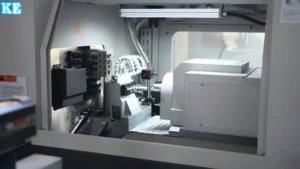
When your hobby turns into business, what you need is speed and precision. This is precisely the advantage of industrial-grade centering machines – the spindle box moves the workpiece through the guide bushing. This design supports the material in the position close to the cutting tool that eliminates deformation.
Why Should Small Factories Consider Centering Machines?
Ultra-high precision: The tolerance can be controlled within ± 0.005mm.
Batch Production: Very suitable for the production of thousands of small and complex parts (such as screws, medical pins, connectors).
Save Space: Compared to its powerful output capacity, the structure of the walker is usually very compact.
For an in-depth understanding of how these machines work, check out this article on The Complete Guide to CNC Lathe Machines.
Focus Recommendation: Jianke Machinery-Built for Precision Small Parts
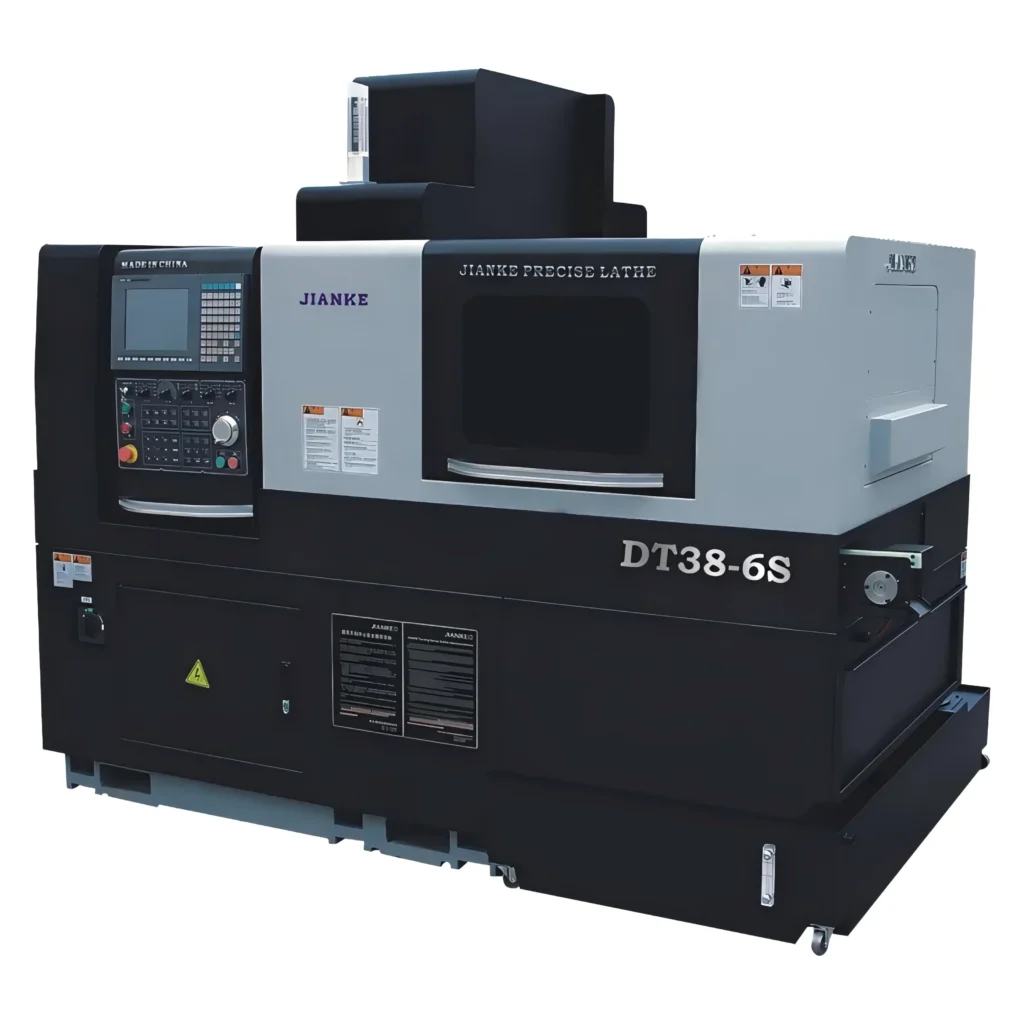
If you are a small processing shop owner, is hesitating centering machines for me to be too high-end? Please consider the long-term value. Dual spindle centering machine DT38-6S, this 6-Axis CNC Lathe provides a perfect balance between industrial-grade power and small footprint. Please look through the blow table of CNC lathe parameters.
| Parameter Table: JIANKE Double Spindle Swiss CNC Lathe | |||
|---|---|---|---|
| Machining Ability | Max processing diameter | 42 mm | |
| Maximum single feeding length | Rotary guide bush | 150mm(Optional) | |
| Without guide bush | 1:2.5D(Dia:Length) | ||
| Main spindle max drilling Dia | axial(main spindle) | Φ23mm | |
| Main spindle tapping Dia | axial | M16 | |
| Rotary tools max drilling Dia | radial | Φ10mm | |
| Rotary tools max tapping Dia | radial | M8 | |
| Sub spindle max drilling Dia | Axial(sub spindle) | Φ10mm | |
| Sub spindle max tapping Dia | axial | M8 | |
| Spindles | Main/Sub spindle type | Internal oil cooling electric spindle | |
| Main/Sub spindle speed | 6000rpm/min | ||
| Main/Sub spindle indexing | 0.001° | ||
| Main/Sub spindle through hole Dia | 44mm | ||
| Main/Sub spindle height | 1090mm | ||
| Others | Power capacity | 34.8kw | |
| Air pressure | 0.4MPa or above | ||
| Capacity of machining oil tank | 340L | ||
| Lathe size | 2.6m×1.5m×2.28m | ||
The Core Advantages of JIANKE Spindle Centering Machine:
- Double Spindle Capability: the front and back of the part can be processed at the same time, and the cycle time is shortened by half.
- High Rigidity: The cast iron base effectively absorbs vibrations and ensures mirror-like finish in processing stainless steel and titanium alloys.
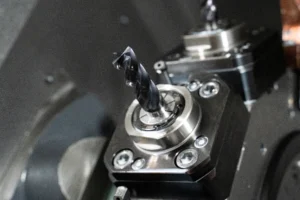
- Multi-functionality: Equipped with Live Tooling, you can complete milling, drilling and tapping in one clamping, turning the lathe into a multi-tasking machining center.
For shops upgrading from 3D printing or manual processing, investing in a rugged machine like the Z-Series CNC lathe ensures that you won’t need to change machines within a year due to lack of capacity.
How to Choose the Right CNC Lathe?
Buying CNC machines is a major project. Before placing an order, please consider answering the questions in the following list:
1. What material do you want to cut?
If you are mainly processing plastic or aluminum, a lightweight desktop lathe is enough. If your main business involves grade 5 titanium alloy, stainless steel or superalloy, you must give priority to the rigidity of the machine and the spindle power. For hard metal processing, cast iron bed is a non-negotiable hard index.
2. What is your typical part size?
Diameter: The diameter of workpieces in most small factories is less than 1.5 inches (38mm). The walking machine is optimized for this range.
Length: If you manufacture slender shaft parts, the walker is the only feasible choice due to the support of the guide sleeve.
3. Your budget and return on investment (ROI)?
Cheap amateur CNC lathes have less upfront investment, but if it often fails or cannot maintain tolerances, it may cause you to lose your contract. A professional machine can usually recover costs within 12-18 months through faster production speeds and lower rejection rates. The following table is for reference only:
| Comparison Table of different CNC Lathes | ||
|---|---|---|
| Feature | Desktop/Hobby Lathe | Industrial/Swiss Lathe |
| Price Range | $4,000 – $15,000 | $40,000+ |
| Tolerance | ±0.05mm | ±0.002mm |
| Spindle Speed | 2,000 – 5,000 RPM | 8,000 – 10,000 RPM |
| Automation | Manual loading | Bar feeder capable |
| Best Use | One-off prototypes | Production runs (500+ parts) |
Essential Accessories for New CNC Lathes
To make the most of your machine, reserve a budget for the following necessities:
- Bar Feeder: Automatic material loading that allows the machine to run all night.
- High-pressure Cooling System: High-pressure coolant can extend tool life and improve surface finish.
- Measurement Tools: If you can’t measure, you can’t manufacture precision parts. Please invest in digital micrometers, or even optical projectors.
Conclusion
The best CNC lathe depends on what level you want your business to reach in five years. For amateurs who are purely for entertainment, the desktop model is fun to use. But for small factories aiming for profitability, precision and growth, upgrading to production-grade CNC lathes is an investment that changes everything.
Ready to explore high-precision machining solutions? Visit JIANKE Machinery to see how our CNC lathe fits perfectly into your small factory workflow.
FAQ
No longer difficult. Although G code is the language of the machine, modern CAM (computer-aided manufacturing) software such as Fusion 360 or Mastercam allows you to visually design parts and automatically generate code. Most modern CNC lathe controllers also have a ‘ dialog programming ‘ feature that allows you to enter simple data without writing code (e.g. ‘turning diameter to 10mm’).
Most industrial machines require three-phase power supply. However, small factories can easily solve this problem with Rotary Phase Converters, which allow you to run industrial equipment on standard single-phase civil or commercial power supplies.
Absolutely. Large manufacturers usually have high management costs and are reluctant to take orders for 500 or 1,000 parts. This ‘medium batch’ range is the capacity range of small factories equipped with precision CNC lathes. You can provide fast turnaround time and personalized services that the giants cannot match.