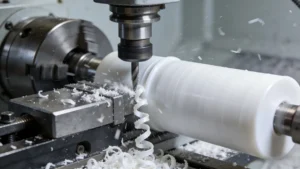
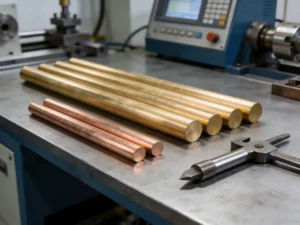
There is no room for error in the highly risky aviation field. When a loose bolt or a tiny crack can cause catastrophic failure, the manufacturing standards must be absolutely stringent. This is where CNC lathes work its magic in aerospace. These sophisticated machines are the backbone of modern aerospace engineering. They can convert unprocessed metal blocks into key components for flight and the tolerances are calculated in microns.
Whether it’s the landing gear of a commercial airliner or the fuel nozzle of a fighter jet, aerospace CNC lathes ensure every part meets stringent flight requirements.
What Are Aerospace CNC Lathes?
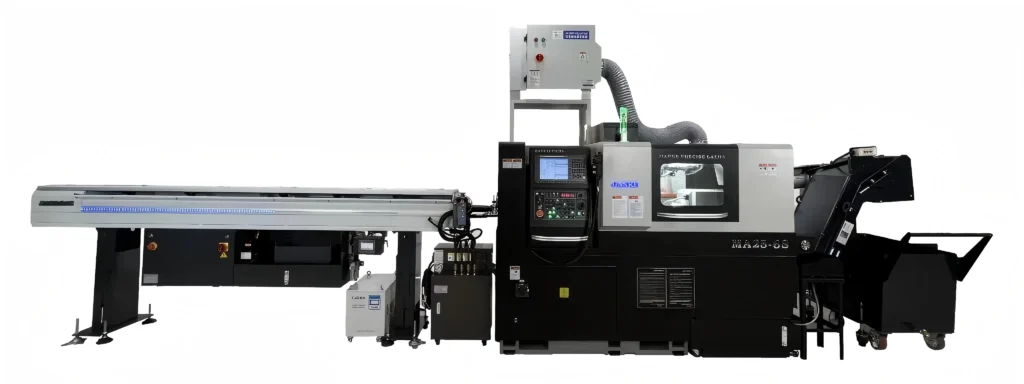
Aerospace CNC lathe is an advanced computer numerical control (CNC) turning center, which is specially configured to deal with complex geometric shapes and special materials in the aerospace industry. These machines, unlike standard lathes used in general manufacturing, are often equipped with multi-axis functions, live tooling and thermal compensation systems to maintain stability over long processing cycles.
What are they different?
Rigidity: It is designed for cutting hard superalloys without vibration.
Precision: CNC lathe can maintain a tight tolerance of +/- 0.0001 inches (about 2.5 microns).
Automation: CNC lathes are equipped with automatic feeders and manipulators that can achieve mass production.
Why is Micron-Level Precision Crucial in Aerospace?
Aviation components usually work in extreme temperature fluctuations, huge pressure and corrosive environments.
Safety and Reliability: A few microns of deviation on the turbine shaft may cause vibration that result in engine failure.
Fuel Efficiency: Precision parts reduce friction and weight that affect fuel economy.
Aerodynamics: The surface finish must be extremely smooth to ensure proper airflow and fluid dynamics within the engine system.
JIANKE Note: Achieving high accuracy depends not only on the machine; it requires advanced software, skilled programming and the synergy of high-quality tools.
Key Advantages of Using CNC Lathes for Aerospace Parts
When manufacturers deploy Aerospace CNC lathes, they unlock a competitive advantage that manual processing cannot match.
Surface Finish Quality
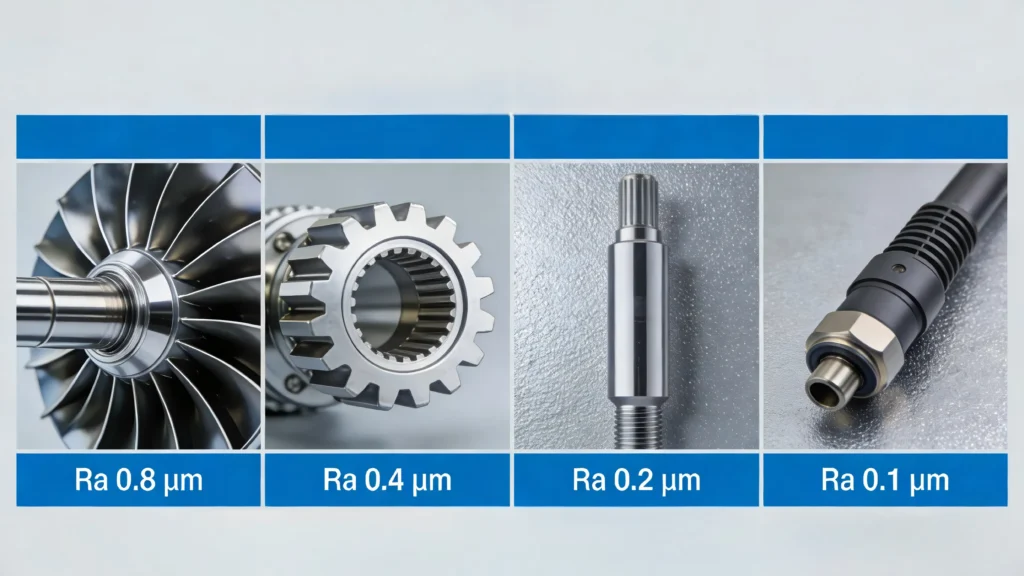
Aviation parts usually require Ra 0.2 µm or better surface finish to prevent fatigue cracks. High-speed Aerospace CNC lathes use advanced cutting strategies to achieve mirror-level finish directly on the machine.
Unmatched Repeatability
In aerospace manufacturing, part A must be exactly the same as part B, even if their production time is several years apart. CNC lathes use programming code to copy parts with 100% consistency that eliminate human errors.
Complex Geometric Shapes
Modern aviation components usually have composite curves and internal channels. Multi-task lathes (combined with turning and milling functions) can process these complex features in one clamping. This “Done-in-One” concept reduces handling time and cumulative errors.
Materials Machined: A Comparative Overview
A defining feature of Aerospace CNC lathes is their ability to cut special materials. These materials are selected for their strength-to-weight ratio and heat resistance, but they are known for being difficult to process.
| Comparison Table: Aerospace CNC Machining Material | |||
|---|---|---|---|
| Material | Properties | Machining Challenge | Common Application |
| Titanium (Ti-6Al-4V) | High strength, low weight, heat resistant | Poor thermal conductivity causing tool wear | Landing gear, airframe structures |
| Inconel (718/625) | Extreme heat and corrosion resistance | Work-hardens rapidly during cutting | Turbine blades, exhaust systems |
| Aluminum (7075) | Lightweight, easy to machine | Prone to deformation if walls are too thin | Fuselage panels, wing ribs |
| Stainless Steel (17-4 PH) | High strength and hardness | Requires high cutting forces | Hydraulic fittings, actuators |
How to Optimize the Efficiency of Aerospace CNC Lathe?
In order to maximize the role of aerospace CNC lathes, manufacturers must go beyond the hardware itself. Optimization involves the overall consideration of the processing process.
Tool Selection
The use of standard cemented carbide tools on Inco nickel alloys is a disaster. Aerospace applications usually need to withstand the high heat generated during the cutting process, so they are equipped with ceramic or CBN (cubic boron nitride) blades and special coatings (such as AlTiN).
High-Pressure Coolant Systems
The standard pouring coolant often cannot penetrate into the cutting zone in high-speed machining. Aerospace CNC lathes are often equipped with high pressure cooling (HPC) systems up to 1,000 PSI to flush away chips and keep the cutting edge cool.

In-Process Metrology
Modern lathes use contact probes to measure parts, but they are still stuck on the chuck, which enables the machine to automatically restore tool wear and ensure that the final size remains within the micron-level tolerance window.
Common Manufacturing Parts in CNC Lathe
The versatility of Aerospace CNC lathes enables them to produce a variety of components.
- Turbine Shaft: Long and slender parts that require center frame support to prevent swing.
- Flange and Ring: the key components connecting the engine part.
- Fasteners: High-strength bolts and screws made of titanium.
- Hydraulic Manifold: complex valve blocks that require precision drilling and turning.
Challenges in Aerospace CNC Machining
Despite advanced functions, operating Aerospace CNC lathes still faces unique challenges that engineers must overcome.
Thermal Expansion
Even if the workshop temperature changes by 1 degree, the geometry of the machine may change by several microns. Top aerospace workshops use temperature-controlled environments and machines with thermal sensors to counteract this effect.
Chip Management
Long, linear chips (commonly found in aluminum and titanium processing) may be wound around the tool or part, destroying the surface finish. The use of chip breaking cycles and high-pressure coolants is essential for automated operation.
Regulatory Compliance (AS9100)
Every aspect of the process, from the source of raw materials to the final inspection, must be recorded. Aerospace CNC lathes are usually integrated with ERP systems to automatically record data to ensure complete traceability.
Learn more about AS9100 quality standards.
Future Trends of CNC Lathe in Aerospace Turning
As we look toward the future of the aviation industry – including hypersonic flight and space exploration – the demand for Aerospace CNC lathes will only increase.
- Hybrid Manufacturing: A CNC lathe that combines additive manufacturing (3D printing) with subtractive CNC turning. It is used to manufacture parts with internal lattice structure.
- AI-Driven Machining: An algorithm that can predict and adjust the feed rate in real time to save parts before tool failure occurs.
- Sustainable Machining: a CNC lathe that uses low-temperature cooling (liquid nitrogen) instead of oil-based coolant to reduce energy consumption and reduce environmental impact.
Conclusion
Aerospace CNC lathe is a tool that connects digital design with the physical reality of gravity. By mastering micron-level precision, mastering difficult-to-machine materials and embracing automation, these machines ensure the continued safe and efficient development of the aerospace industry.
For manufacturers looking to enter this field, investing in high-quality Aerospace CNC lathes is not just an option – it is a prerequisite for success.