Yes, 9-axis CNC lathes do exist. They are typically advanced multi-tasking machine tools that integrate turning and milling functions with the “9-axis” referring to the total number of controllable motion axes. Firstly let’s understand CNC machines and CNC lathe.
The Difference Between CNC Lathe and CNC Machine
CNC machine and CNC lathe are not mutually exclusive terms; they describe different aspects of machining. CNC machine refers to a control method, CNC lathe is a type of machine/tool. Key differences and how they relate:
Lathe is a machine tool that rotates a workpiece about an axis while stationary cutting tools remove material. Typical lathe operations: turning, facing, boring, threading and grooving.
CNC (Computer Numerical Control) is a method of controlling machine tools (including lathes, mills, routers and grinders) using a programmed numeric code (G-code/M-code) executed by a controller to move axes and actuators precisely.
Scope
CNC lathe: specific machine category (turning-centric).
CNC machine: control technology applied across many machine types.
Manual vs. CNC lathe
Manual (engine) lathe: operator sets speeds, feeds and hand-moves the carriage/tool; skilled operator required for complex shapes.
CNC lathe: automated, follows a program to produce complex geometries with repeatability and minimal manual intervention.
Precision and Repeatability
CNC systems provide higher consistency, tighter tolerances, and automated compensation compared with manual lathes.
Complexity of Parts
CNC lathes can produce intricate contours, threads, tapers and repeat complex cycles; manual lathes are better for simple shapes, one-offs or when operator judgment is required.
Productivity
CNC lathes run unattended or with minimal supervision, faster set-ups for batch runs, higher throughput. Manual lathes are slower and labor-intensive for volume work.
Features and Capabilities
CNC lathes often include live tooling, multiple axes (C-axis, Y-axis), sub-spindles, automatic tool changers, bar feeders that enable milling, drilling and complex multi-operation parts on one machine.Conventional lathes are limited to basic turning operations and single-tool setups.
Cost and Infrastructure
CNC machines have higher upfront cost (machine, controller, software, training), but lower labor per part and lower scrap rates in production.
Manual lathe is cheaper capital-wise and simpler to maintain than suitable for prototyping, education, low-volume or repair work. Its work requires hands-on machining skills and experience.
CNC machines require programming (G-code or CAM), setup skills and understanding of tooling, but less manual tool movement.
New 9-axis CNC Lathe
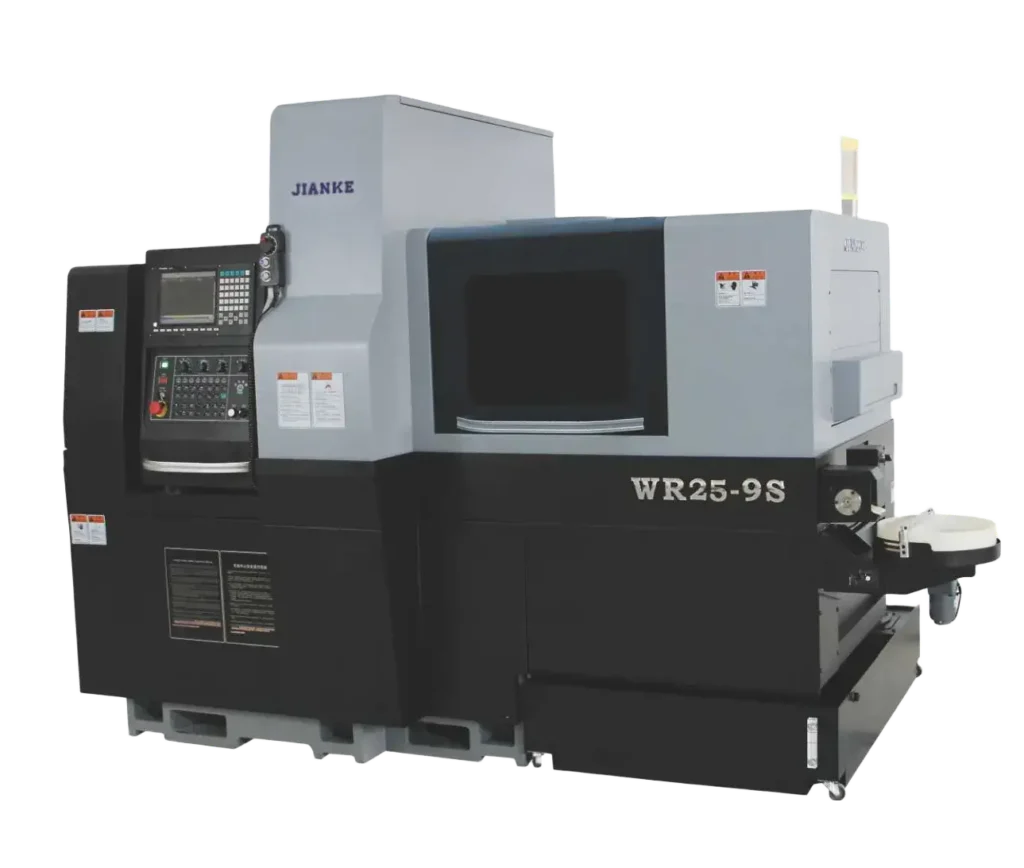
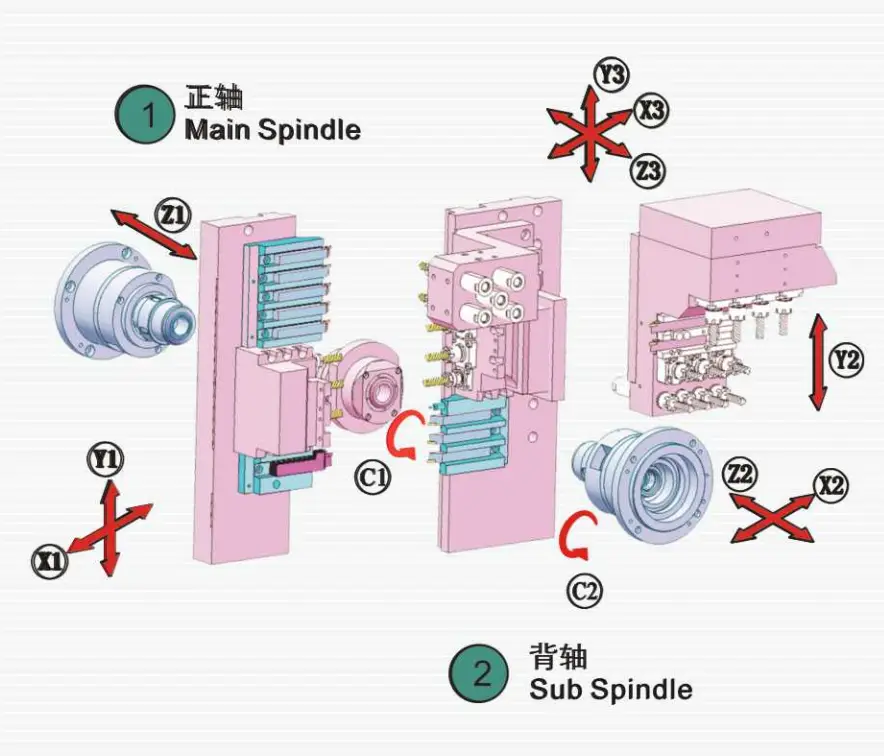
Jianke Machinery is proud to present its new 9-axis CNC lathe WR25-9S with two independently mounted tool rows on each side that enable simultaneous milling and drilling operations. It also includes a sub-spindle Y2 axis that allows simultaneous operation of both the main spindle and sub-spindle. LM port guideways and screws ensure high precision and stability.
| Specifications | ||
| Max.machining diameter | Φ25mm Φ25mm | |
| Max.headstock stroke | With guide bush | 200mm |
| Without guide bush | 1:2.5D | |
| Fixed boring tool | Max.drilling capability | Φ10mm |
| Max.tapping capability | M8 | |
| Power-driven attachment | Max.drilling capability | Φ8mm |
| Max.tapping capability | M6 | |
| Spindle speed | max.6000min-1 | |
| Driven motor | 1.0kw | |
Get a Quote Now
Jianke Machinery‘s 9-axis CNC lathe has a range of CNC machining functions that can combine various CNC machine capabilities to produce simple and extremely complex geometries.
If you want to process a raw material blank directly into a finished product on a single machine with maximum efficiency and precision, it is your nice choice. Please contact us if you would like to learn more.