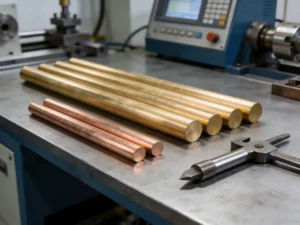
Multi-axis CNC lathes are preferred machines for producing high-precision and complex parts in precision manufacturing. But why should you choose a 6-axis CNC lathe over a two- or three-axis CNC lathe? Let’s explore the unique features, advantages, limitations and applicable industries of six-axis CNC lathe.
What is a 6-axis CNC lathe?
What we often refer to as a “six-axis CNC lathe” is more accurately known as a “turn-mill machining center” or “multi-tasking machine.” Unlike traditional lathes that can only move in a single axis (forward and backward), the 6-axis CNC lathe can achieve multi-directional movement: it is not just capable of turning but is a high-end CNC machine tool that integrates multiple functions such as turning and milling (including boring, drilling, tapping, etc.).
Components
Basic Structural Components
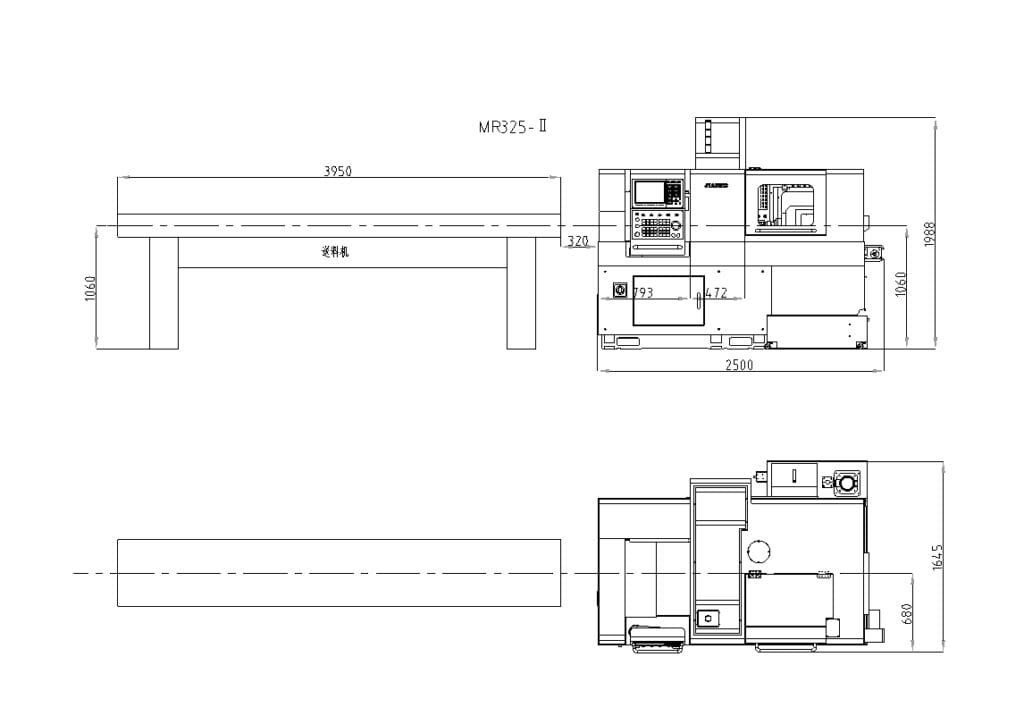
The machine bed is typically constructed of high-strength, high-quality cast iron and undergoes an aging treatment to ensure long-term structural stability and vibration resistance. The design allows for smooth chip and coolant drainage. The base and column provide sturdy support for the turret and milling spindle. They together support all components and maintain stability.
Spindle System
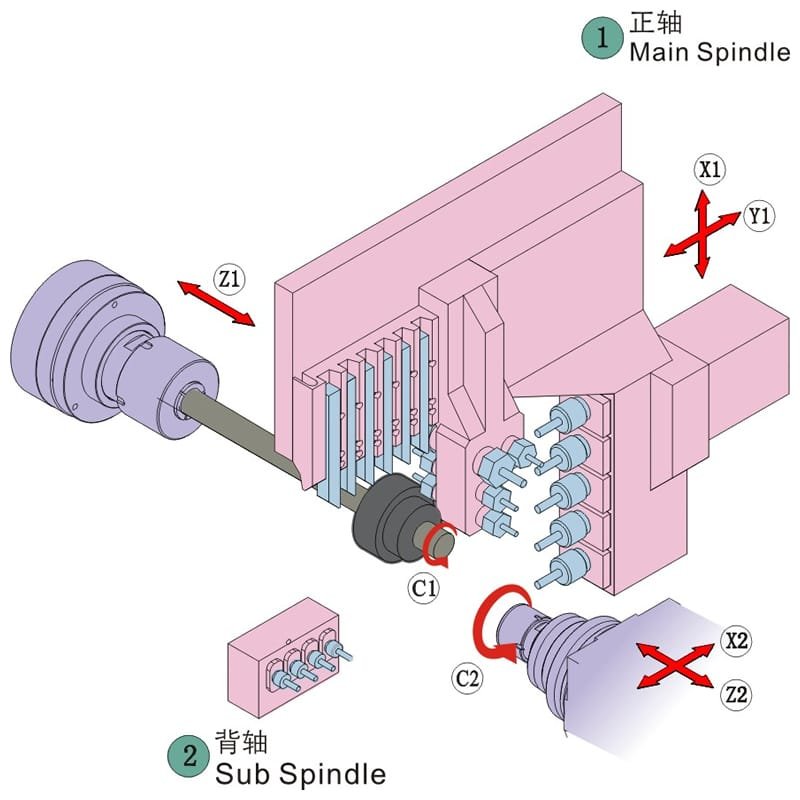
The core power source of a 6-axis CNC lathe consists of two spindles. The main spindle is typically a high-power and high-torque electric spindle capable of high-speed turning and can also function as a C-axis: it can rotate continuously for turning as well as perform precise angular indexing and interpolation that enable milling operations in conjunction with the turret.
The sub spindle that is located opposite the first can move in the Z-axis. It can take over the workpiece after the main spindle has finished machining and then machine the other end of the part that achieves “one-clamp, completes machining” and eliminates secondary clamping errors.
Turret System
The 6-axis CNC lathe’s powered turret can install turning tools and rotary-driven milling cutters or drills. Each tool station is driven by an independent servo motor that enables rotary milling, drilling and tapping operations similar to the spindle of a machining center. The tool can move along the machine’s X and Z axes. If the machine has a Y axis, the live tool can also move in the Y axis.
Feed System
Servo motors provide precise power for each axis of a six-axis CNC lathe.
A ball screw converts the servo motor’s rotational motion into linear motion that drives the slide. Pre-stretched precision ball screws are used to reduce thermal deformation.
Linear guides support and guide moving components (such as the turret slide and subspindle slide) for smooth and precise movement.
CNC System
The CNC system interprets the machining program and simultaneously controls the coordinated motion of six or more servo axes (such as X, Y, Z, C, C’, and B) (i.e., multi-axis linkage). It can handle complex mixed programming commands for turning, milling, drilling and tapping and offers advanced features such as tool center point management, collision avoidance and high-speed, high-precision machining.
Auxiliary Systems
Automatic feeder: can realize continuous automatic feeding and long-term unmanned production.
Cooling System: flushes the tool and workpiece and dissipates cutting heat. High-pressure coolant flowing through the spindle and tool center can be used for deep-hole drilling and chip removal.
Chip Conveyor: automatically removes chips from the machine that ensure a clean machining area and continuous automated operation.
Lubrication System: provides timed and quantitative lubrication to moving parts such as guideways and lead screws.
Hydraulic/Pneumatic System: powers actions such as chuck clamping, tailstock tightening and toolholder locking.
Benefits
Improved Precision
A 6-axis CNC lathe achieves high precision that ensures parts meet exact specifications. This level of precision is crucial in industries such as aerospace, automotive and medical device manufacturing.
Complex Part Production
The 6-axis CNC lathe has multi-directional motion capabilities and can process complex geometries and multi-sided parts that are difficult to handle with traditional machine tools. This provides a wide range of design possibilities for engineers and designers.
Improved Time Efficiency
A 6-axis CNC lathe reduces the need for multiple setups and tool changes by integrating multiple operations into a single machine that can shorten production time and reduce overall lead time.
Cost-Effective for High-Volume Production
While the initial investment for a six-axis lathe may be higher, its ability to process complex parts in a single operation can reduce labor and tooling costs especially in high-volume production.
Limitations
High Initial Investment
The complexity and advanced technology of a six-axis CNC lathe mean its initial cost is higher than that of traditional machine tools. Small businesses or factories with limited budgets may find this a barrier to entry.
Experience Requirements
Operating a six-axis CNC lathe requires specialized training. While traditional CNC operators may be able to adapt , the programming and operation of a six-axis machine requires time and expertise.
Maintenance Costs
Due to the complexity of multiple moving parts, a six-axis CNC lathe can be more expensive to maintain. Regular maintenance and repairs require skilled technicians that further increases operating costs.
Sample Machine
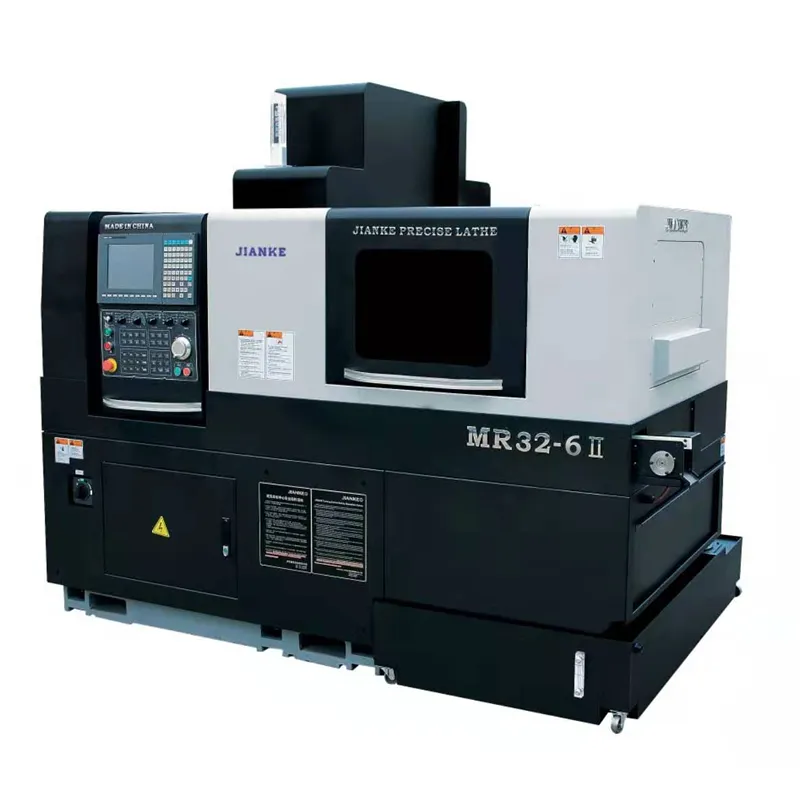
Jianke Machinery has introduced the new MR32-6II, a 6-axis CNC lathe with a dual-spindle configuration. As mentioned above Jianke Machinery’s six-axis CNC lathe features a dual-spindle configuration that designs for fast and accurate centering of cylindrical workpieces up to 32 mm in diameter. Equipped with two independently controlled spindles mounted on precision linear guides and driven by powerful AC servo motors, the machine can simultaneously center two workpieces.
With a centering accuracy of ±0.005 mm, the MR32-6II is ideal for high-precision applications in industries such as automotive, aerospace, bearing and hydraulic component manufacturing. The Siemens PLC control system coupled with an 8.4-inch color touchscreen HMI provides intuitive operation and key parameter monitoring. In addition to its high performance, the MR32-6II has a footprint of just 1200 x 1100 mm that is suitable for shops with limited floor space.
Main Applications
Aerospace Industry
Engine Components: Machining turbine blades, blisks, engine shafts and casings that are often made of difficult-to-machine high-temperature alloys and titanium alloys with complex structures and numerous curved surfaces. 6-axis CNC lathe can perform all blade profile milling, tenon turning and cooling hole drilling operations on a single machine that ensures extremely high geometric tolerances and surface quality.
Landing gear components: Large, high-strength steel or titanium alloy components require complex turning, milling and deep-hole drilling.
Aerospace structural components: Various special-shaped brackets and joints require machining at multiple angles.
Medical Device Manufacturing
Artificial joints: Such as femoral stems and acetabular cups for hip and knee joints that have complex and ergonomic curved surfaces and require a high-quality mirror finish. A 6-axis CNC lathe can complete the entire process from turning the basic shape from bar stock to fine-milling the curved surfaces and then drilling and tapping.
Surgical instruments: Bone drills, scalpel handles and endoscope components are typically made of stainless steel or titanium alloys that feature compact and precise structures and numerous cross-holes, threads and special-shaped grooves.
Dental implants: Dental implants, etc., require high-precision threads and specialized surface treatments.
Automotive Industry (especially high-performance sectors)
Core engine components: Such as turbocharger rotors, engine camshafts and racing engine crankshafts that require machining of the center hole, outer diameter, end faces, keyways and inclined oil holes in a single clamping operation to ensure absolute dynamic balance and coaxiality.
Transmission system components: Complex differential housings, transmission gear shafts, etc.
Racing and high-performance custom parts: Small-batch suspension steering knuckles, universal joints, etc.
Military and Defense Industry
Ammunition fuses: Extremely complex structures and extremely high safety requirements require multi-faceted machining and precision threads.
Missile components: Servo housings, missile body connectors, etc., require lightweight and high strength.
Core firearm components: Barrels, receivers, etc., require stringent dimensional and fitting accuracy.
Energy Equipment Manufacturing
Oil and Gas: Valve bodies, drilling tool joints, downhole tools, etc. that often need to withstand high pressures and extreme environments and their structures are complex with numerous sealing grooves and threads.
Hydraulic Systems: Hydraulic valve blocks, pump housings, pistons, etc. with complex internal oil circuits and precision mating surfaces.
Precision Instruments and High-End Consumer Goods
Watchmaking: Watch cases, crowns and movement components require extremely high surface quality and detail.
Optical Equipment: Lens barrels, lens mounts, etc.
Audio Equipment: Metal diaphragms and housings for high-fidelity speakers, etc.
Conclusion: The Future of Multi-Axis Lathes Has Arrived
6-axis CNC lathe is revolutionizing the manufacturing industry that offers unprecedented accuracy, speed and multi-function. While six-axis CNC lathe has a higher initial cost and require specialized training, their advantages far outweigh their limitations for industries that need to efficiently produce complex and high-quality parts. As technology advances, the popularity of six-axis lathes is expected to continue to grow and drive innovation across various industries.