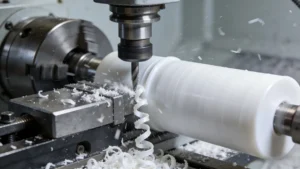
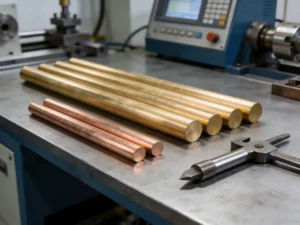
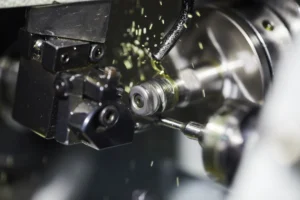
Traditional lathes with two or three axes primarily perform turning tasks (external turning, internal bore turning, end face turning, threading, etc.) on rotating parts such as shafts, sleeves and disks. Six-axis CNC lathes offer more complex machining capabilities that enable automation and reduce labor costs corresponding to the trend of modern intelligent manufacturing.
What is CNC Lathe?
A CNC lathe is a machine that holds and spins a workpiece by its main spindle while feeding a set of tools on a turret along linear axis X, Y, Z to cut the various surfaces of the workpiece that include its inner diameters, outer diameters, end face, holes, threads corresponding to the cutting operations of turning, facing, drilling, threading.
Six-Axis CNC lathe vs. Other CNC lathes
| Type | 3-Axis CNC Lathe | 5-Axis CNC Lathe | 6-Axis CNC Lathe |
| Typical Axes | X,Z,C | X, Y, Z, C, and either a Live Tool (B) or Sub-Spindle | X, Y, Z, C, and a Live Tool (B), plus a Sub-Spindle |
| Key Capacities | -All 2-Axis capacities:Basic turning,Facing,Grooving,Threading -Off-center drilling & milling (using C-axis and live tools) | -All 3-Axis capabilities -Simultaneous 4/5-axis milling on complex contours -Complete part machining in one setup | -All 5-Axis capabilities -Simultaneous machining on both ends of a part -Highest level of complexity in one setup |
| Advantages | Adds milling/drilling to the turned part without a second setup. | Ultimate flexibility for complex geometries; “Done in One” for most parts. | Maximum productivity and complexity; two spindles working in tandem for minimal cycle times. |
How does a 6-Axis CNC Lathe Work?
Six-axis CNC lathe uses advanced programming technology to control tool and workpiece motion that allows simultaneous movement in six directions: three linear axes (X, Y, and Z) and three rotary axes (A, B, and C).
The X and Z axes control the forward, backward and left and right movement of the turning tool that finishes basic turning operations.
The C axis allows the spindle (and workpiece) to be precisely indexed and positioned to any angle.
The Y axis allows vertical tool movement, enabling true off-center milling.
The B axis (or second spindle) can be a rotating subspindle that takes over the workpiece from the main spindle to automatically machine the backside of the part without re-clamping.
Besides it can be a B-axis milling head with a live tool: A milling head with a live tool can oscillate around a single axis (the B axis) that allows the tool to approach the workpiece at the optimal angle and enables the machining of complex features such as bevels and angled holes.
How to Choose the Right CNC Lathe for Your Needs
Choosing the right CNC machine depends on a variety of factors that includes the type of parts you need to produce, the materials you’re machining and the level of precision required.
Consider part complexity: If you’re manufacturing simple parts, a 3- or 4-axis lathe may be sufficient. For highly complex parts, a 6-axis CNC lathe is the first choice.
Consider material compatibility: Make sure the CNC lathe you choose can handle the material you want to machine, whether it’s metal, plastic or another substance.
Evaluate accuracy and speed: 6-axis lathe is generally faster and more accurate than lower-axis machines that is crucial if you’re machining high-tolerance parts.
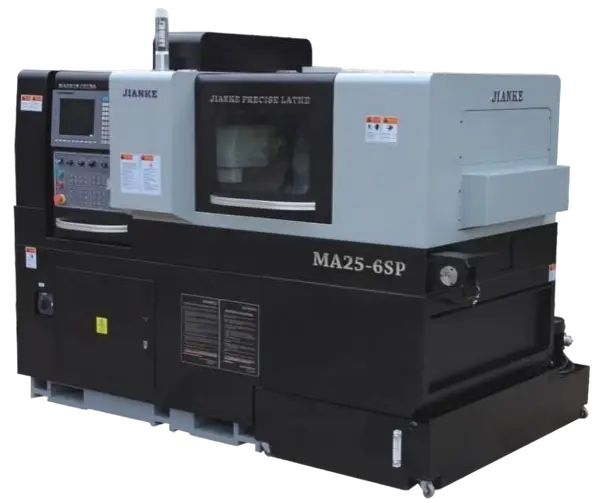
Jianke Machinery produces a 6-axis CNC lathe-the Dual Spindle CNC Centering Machine MA25-6S. It features a dual-spindle design that allows simultaneous machining of two workpieces that improves efficiency and productivity.
Its 6-axis CNC control system provides high precision and operational flexibility, while the servo motor-driven spindle ensures smooth and reliable performance.
It’s also easy to operate and monitor and suitable for a variety of work environments due to its user-friendly touchscreen interface and compact, rugged design.
Final Thoughts
Six-axis CNC lathe offers unparalleled versatility, precision and efficiency, making them an ideal choice for industries that demand the production of complex, high-quality parts. Understanding the differences between different types of CNC lathes will help you make an informed decision and select the machine that meets your specific needs.
Jianke Machinery as an innovative leader in the CNC machine tool industry specializes in providing customers with high-quality, efficient CNC machine solutions. If you’re still unsure about which machine to choose, send us your drawings and our technicians will provide you with reliable advice and assistance.